Looking for a reliable 1 gallon vacuum chamber kit to remove air bubbles from resins, silicones, and epoxies? This guide highlights top options that balance durability, ease of use, and value. Each pick is suited to different workflows—choose based on chamber material, lid type, and pump compatibility. Below is a quick buyer’s table summarizing the featured models.
| Product | Chamber Material | Lid Type | Pump Included | |
|---|---|---|---|---|
| BACOENG 1 Gallon Acrylic Vacuum Chamber | Acrylic | Acrylic Lid | Not included | Clear viewing, quick defoaming observation |
| BACOENG 1 Gallon Flat Vacuum Chamber Kit | Stainless Steel | Acrylic Lid | Not included | Durability and long-term use |
| VIVOHOME 1.5 Gallon with Pump | Stainless Steel | Acrylic Lid | Yes (3.5 CFM) | Integrated pump and gauge for streamlined workflow |
| Orion Motor Tech 2 Gal with Pump Kit | Stainless Steel | Tempered Glass Lid | Yes (3.5 CFM) | Wood stabilization and versatile degassing |
| VEVOR 1.5 Gallon Kit | Stainless Steel | Acrylic Lid | Yes (3.5 CFM) | High vacuum performance with clear lid for monitoring |
BACOENG 1 Gallon Acrylic Vacuum Chamber

The BACOENG acrylic chamber is a lightweight, transparent option designed for quick visual monitoring. The 1 gallon size is well-suited for hobbyists and small-scale resin projects. Best for users who want to clearly watch the degassing process through a large, transparent window. The kit emphasizes reusability with a silicone gasket and a durable acrylic body that can endure frequent use. A potential limitation is that this model does not include a pump, so buyers must supply a compatible vacuum source separately.
Best for: hobbyists and makers who prioritize visibility and ease of observation during defoaming. Choose this if you want a straightforward, no-frills chamber to pair with your own vacuum pump.
Caution: Ensure you have a compatible 1/4″ SAE vacuum pump and hoses, as the kit does not include a pump. The acrylic lid provides good light transmission but can scratch with rough handling.
BACOENG 1 Gallon Flat Vacuum Chamber Kit

This stainless steel vacuum chamber emphasizes robustness and long life, featuring a silicon gasket for a tight seal and an acrylic lid for material observation. The 1 gallon measurement handles typical small-batch resin and silicone tasks with ease. It is best for users who expect frequent use and prioritize a durable chamber that resists wear. A limitation is that the kit does not include a pump, so acquisition of a compatible pump is necessary.
Best for: users who need a rugged chamber that can withstand repeated degassing cycles without warping. Choose this if you want a steel body with a clear lid for ongoing projects.
Caution: Verify compatibility with your vacuum pump’s connections and seals. Stainless steel construction may feel heavier to move and handle than acrylic models.
VIVOHOME 1.5 Gallon Vacuum Chamber with Pump
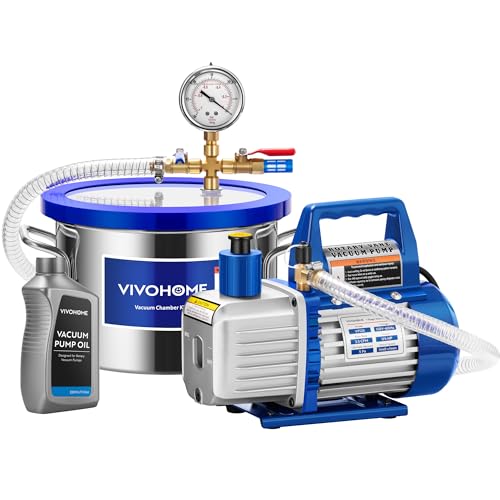
This kit pairs a 1.5 gallon stainless steel chamber with a 3.5 CFM single-stage vacuum pump. The integrated pump simplifies setup and reduces the chance of mismatch between chamber and pump. The chamber’s gauge helps users monitor pressure in real time, supporting precise defoaming. It’s best for those who want an all-in-one solution for resin, epoxy, and silicone degassing. A caveat is that the 1.5 gallon size is larger than a strict 1 gallon requirement, which may affect space planning.
Best for: projects that require a reliable, integrated pump setup with live vacuum monitoring. Choose this if you want a more complete kit that minimizes additional purchases.
Caution: The larger chamber size may not fit tighter workspaces. Confirm that 1.5 gallons is acceptable for your intended applications before purchasing.
Orion Motor Tech 2 Gal Vacuum Chamber Kit

This kit delivers a larger 2 gallon stainless steel chamber paired with a 3.5 CFM vacuum pump. The tempered glass lid provides a robust seal, while the liquid-filled gauge helps users monitor degassing progression. This option is best for wood stabilization, larger resin or silicone molds, and applications requiring stronger chamber walls. A limitation is the higher footprint, which may be less suitable for compact workspaces.
Best for: users who need a sturdier, larger chamber and a capable pump for demanding degassing tasks. Choose this if your projects exceed 1 gallon and you require higher chamber rigidity.
Caution: Ensure your workspace can accommodate a 2 gallon setup, and handle the tempered glass lid carefully to avoid impact damage.
VEVOR 1.5 Gallon Chamber Kit

VEVOR offers a stainless steel 1.5 gallon chamber with a 3.5 CFM pump and an acrylic lid for rapid observation. The kit’s 5 Pa ultimate vacuum enables thorough degassing and is suitable for resins, silicones, and epoxies. It features a cooling fan and anti-backflow design to improve longevity and reliability. Best for users who want a strong vacuum kit with a transparent lid for real-time process monitoring. A noted limitation is that it is explicitly not recommended for wood stabilization tasks.
Best for: those seeking a high-performance vacuum setup focused on resin, silicone, and epoxy degassing with clear lid visibility. Choose this if your workflow prioritizes consistent vacuum strength and monitoring capability.
Buying Guide: Key Considerations for 1 Gallon Vacuum Chambers
- Chamber material: Acrylic chambers offer light transmission and visibility; stainless steel provides higher durability and stability under pressure but can be heavier.
- Lid type: Acrylic or tempered glass lids let you observe bubble removal; ensure gaskets provide a reliable seal to prevent air leaks.
- Pump compatibility: Some kits include a pump; others require a separate purchase. Check the pump’s flow rate (CFM) and vacuum level (inHg) to match your materials.
- Gauge visibility: A liquid-filled gauge helps track degassing progress; ensure the gauge is easy to read during operation.
- Space and footprint: Larger chambers require more workspace. Measure your area to ensure safe handling and setup.
- Intended materials: If you work with wood stabilization, confirm whether the kit is suitable for wood or if it’s better suited for resins, silicones, and epoxies (as some kits note restrictions).
Frequently Asked Questions
- What size of vacuum chamber is best for hobbyists?
For hobbyists, a 1 gallon or 1.5 gallon chamber typically balances space, cost, and performance well for resins and silicones.
- Do I need a pump with a 1 gallon chamber?
Some kits include a pump; others do not. A pump is essential to create the vacuum, so plan to pair the chamber with a compatible 1/4″ SAE pump if it isn’t included.
- What materials are most durable for daily use?
Stainless steel chambers are generally more durable and resistant to deformation under vacuum, while acrylic chambers offer visibility but can scratch with rough handling.
- Is a larger chamber always better?
Not always. Larger chambers provide more capacity but require more space and may be less efficient for very small batches. Choose based on your typical project size.
- Can I use these for wood stabilization?
Some models are designed for resin, silicone, and epoxy degassing; others support wood stabilization. Review product notes to ensure compatibility with your intended process.
- What is an acceptable vacuum level for degassing?
High-quality kits can reach around -29 to -30 inHg. Vacuum level depends on the pump and chamber design; higher numbers indicate stronger degassing capability.
Add a Comment