Answering the question: which hydraulic pump control valve best fits your equipment and application? This guide highlights five solid choices for controlling hydraulic flow, pressure, and actuator movement across tractors, loaders, excavators, and dump truck setups. Each selection targets specific use cases—whether you need precision detent control, rugged alloy steel construction, or multiple spool configurations. The following sections explain who should pick each valve, why it’s suitable, and potential limitations to consider before buying.
Summary of selected products:
- Waltyotur 2750 PSI Hydraulic Log Splitter Directional Control Valve
- SINOCMP KDRDE5K-20/40C07-109 Solenoid Valve Kit Replacement
- Magister Hydraulic Control Valve – 1 Spool, 13 GPM
- Magister Hydraulic Control Valve – 2 Spool, 13 GPM
- Vevor 3 Spool Hydraulic Control Valve – 11 GPM
Waltyotur 2750 PSI Valve With Auto Return Detent

Best for small tractors, loaders, and light wood-splitting setups that require a simple, self-return detent on the lever. This valve handles up to 21 gpm and a maximum 3625 psi, making it a practical choice for compact machines needing reliable open-center or detent-controlled extension/retraction. The single-spool design simplifies installation and operation, which is ideal for DIYers or operators who want straightforward control without multiple pilot ports. Caution: ensure the inlet/outlet matches SAE ring fittings on your system.
Best for: operators of small tractors or wood splitters who want an auto-return detent on a single-spool valve. Why chosen: compact, rugged, and designed for auto detent applications with a clear extend/retract behavior.
SINOCMP KDRDE5K-20/40C07-109 Solenoid Valve Kit Replacement
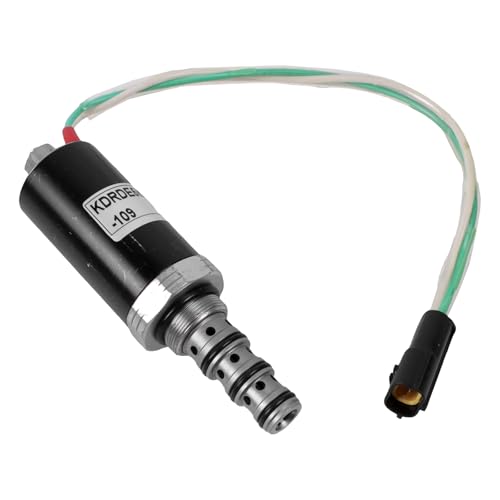
Best for Hyundai excavator configurations needing a dedicated solenoid valve kit. This kit covers multiple part numbers (KDRDE5K-20, 40C07-109, XJBN-00382, XJBN-00014) and fits several Hyundai R-series machines, including R215-7 and R225-7 models. It’s built to withstand vibration and oil contaminants better than standard valves, offering reliable electronic actuation for precise valve control. Caution: verify compatibility with your exact model and old valve numbers before ordering to avoid cross-compatibility issues.
Best for: Hyundai excavator operators replacing a worn valve with a cross-reference part. Why chosen: broad cross-reference compatibility and rugged alloy-steel construction improve longevity under vibration and debris-prone environments.
9N640 Hydraulic Pump Control Valve For Ford 9N/2N

Best for classic Ford 9N/2N tractors requiring a straightforward hydraulic control valve replacement. This aftermarket valve replaces part numbers 9N640 and WN-9N640 and is positioned as a direct fit replacement for select 9N/2N transmissions. Caution: does not fit 8N models, so model compatibility matters. Best used when OEM replacements are unavailable and compatibility aligns with listed part numbers.
Magister Hydraulic Control Valve – 1 Spool

Best for compact machines that need a 1-spool, 4-way, 3-position open-center valve with a 3600 psi rating. It supports up to 13 GPM and uses SAE ports. It’s a practical pick for light loaders, tractors, and small hydraulic circuits where space is limited and straightforward open-center operation is sufficient. Caution: verify port sizes and coil compatibility for solenoid control if you plan to convert to electronic actuation later.
Magister Hydraulic Control Valve – 2 Spool

Best for larger or more demanding hydraulic circuits that require independent control of two actuators. The 2-spool, 4-way, 3-position open-center design supports 13 GPM and 3600 psi, enabling more complex sequencing than a single-spool valve. Choose this for multi-function loaders or dual-acting cylinders. Caution: ensure you have space and plumbing to route additional lines to the second spool without interference.
Vevor 3 Spool Hydraulic Control Valve – 11 GPM

Best for applications needing three independent circuits, such as dual-acting cylinders plus auxiliary equipment. This valve handles up to 11 GPM with a 3600 psi rating and features three spools with SAE O-rings. It’s suitable for tractors and loaders that require precise, separate control of multiple hydraulic functions. Caution: lower flow relative to some 13 GPM units; ensure your system does not require higher throughput.
Buying Guide
What to consider when choosing a hydraulic control valve
- Flow rate compatibility: Match the valve’s GPM rating to your pump and cylinders. Overestimating flow can cause pilot pressure issues; under-sizing can reduce speed.
- Pressure rating: Ensure PSI rating covers your system’s maximum pressure, plus a safety margin for peak loads.
- Spool configuration: Decide between 1-spool, 2-spool, or 3-spool based on how many actuators you need to control simultaneously.
- Open-center vs closed-center: Open-center valves work well for systems with variable loads; closed-center valves are better for high-efficiency, pressure-compensated circuits.
- Port size and type: SAE ports are common; verify inlet/outlet sizes to fit your hoses and fittings.
- Material and build quality: Alloy steel and cast-iron bodies offer better wear resistance in harsh environments; consider contaminants and vibration tolerance.
- Electrical vs mechanical actuation: Solenoid valves provide electronic control, while mechanical detents or levers suit manual operation and simplicity.
- Physical footprint and mounting: Check available space and mounting patterns to ensure a proper fit on your machine.
Single-spool vs multi-spool: which is right for you?
- Single-spool valves: Ideal for simple on/off or extend/retract tasks in compact setups.
- Two-spool valves: Better for dual-cylinder systems or added functions without a complex valve bank.
- Three-spool valves: Best for three separate hydraulic circuits but require more space and plumbing.
Installation and maintenance tips
- Use proper seals and torque fittings to prevent leaks at high pressure.
- Contour lines and routing should minimize bending radii to avoid pressure drops.
- Regularly inspect for oil contamination, as debris can accelerate wear on valve seats.
Frequently asked questions
- What is a hydraulic control valve used for? – It directs hydraulic fluid to control actuators like cylinders and motors, enabling precise movement and force control.
- What does “open center” mean? – An open-center system allows flow to return to the reservoir when no valve is activated, reducing pressure requirements.
- Do I need a solenoid valve or a mechanical valve? – Solenoid valves enable electronic control for automation; mechanical valves are simpler for manual operation.
- How do I choose the correct port size? – Match the valve ports to your hoses, usually SAE sizes; improper sizing can cause leaks or flow restrictions.
- Can I upgrade from single to multi-spool later? – Yes, but plan for mounting, plumbing, and control wiring as your system expands.
Add a Comment