Choosing the right industrial powder coating oven depends on project size, power requirements, and heat control. This guide compares five top options from trusted brands, highlighting features like curing temperature ranges, airflow, and timer controls. Whether you’re coating small parts or mid-size components, these ovens balance performance and practicality for professional and serious hobbyist use.
| Product | Brand | Key Benefit | Link |
|---|---|---|---|
| Eastwood HotCoat PCS-250 Powder Coating Gun Plus Benchtop Oven and Booth | Eastwood | Fast curing, versatile dual-volt settings | Amazon |
| Eastwood HotCoat PCS-250 System and Benchtop Oven Kit | Eastwood | Low profile, clear powder flow, see-through bottle | Amazon |
| Eastwood Hotcoat Bench Top Powder Coating Oven | Eastwood | Compact design with built-in timer and circulation fan | Amazon |
| JEGS Bench Top Powder Coating Oven | JEGS | Up to 450°F, large internal dimensions, built-in timer | Amazon |
| RYIRSHOH Drying Oven 1000W 45L | RYIRSHOH | Two tiers, large capacity, adjustable 10–300°C | Amazon |
Note: The table highlights five products that align with typical industrial and mid-volume powder coating needs. Each entry provides a distinct balance of capacity, heat control, and ease of use, helping buyers compare key capabilities at a glance.
Eastwood HotCoat PCS-250 Powder Coating Gun Plus Kit

The PCS-250 kit emphasizes economy and speed, enabling quick color changes and coating with two voltage settings for coverage on varied part sizes. The system supports rapid coating workflows, with a benchtop oven designed to heat efficiently and distribute heat evenly using upper and lower elements plus an air circulation fan. This setup suits small to medium-sized projects where consistent curing and color reliability are essential.
Key features include dual voltage options (low 15,000V and high 25,000V) suitable for multi-coat applications on larger areas, and a benchtop oven that ramps up quickly to regulate heat distribution. This configuration targets shops looking for a compact, integrated solution that reduces setup time and ensures durable powder finishes.
Eastwood HotCoat PCS-250 System and Oven Kit

This variant emphasizes household-current compatibility (120V/60Hz) with two power levels for two-stage coating coverage. It includes a clear bottle for powder visibility and proceeds through a powder flow with improved internal passages to support smooth flow and consistent application. The kit is designed to accommodate a range of powder types and part geometries, making it suitable for hobbyists expanding toward more frequent powder coating tasks.
Eastwood Hotcoat Benchtop Powder Coating Oven

Eastwood’s compact curing oven provides precise control over heat distribution with independent upper and lower 400W elements and built-in timer. An integrated fan circulates air to maintain even temperature across the chamber, supporting uniform cure cycles for smaller components or groups. The unit’s compact footprint makes it a practical choice for bench-based operations in small shops or garages, delivering dependable results without a large footprint.
JEGS Bench Top Powder Coating Oven
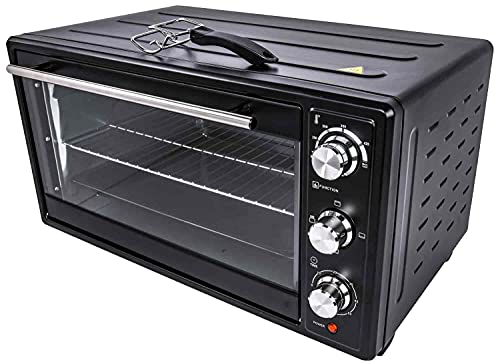
The JEGS option offers a large internal footprint (up to 17″ x 12.5″ x 11″) and a 450°F maximum operating temperature. A three-foot power cord adds flexibility in shop layouts, reducing the need for additional outlets or extension cords. This model targets more robust, mid-size parts that require a broader curing area, making it a practical choice for hobbyists progressing to moderately larger projects.
RYIRSHOH 1000W Drying Oven 45L

The RYIRSHOH unit emphasizes a larger 12-gallon capacity with two tiers and a 10–300°C range, enabling batch drying and curing of multiple parts at once. Its stainless-steel liner and natural convection promote efficient, uniform heating. While positioned as a general-purpose drying oven, it can serve powder coating workflows that require longer cure times or higher capacity between coats for moderate-volume operations.
Buying Guide: Key Purchase Considerations
- Project size and scalability: Choose an oven with a capacity that matches your typical part size and batch volume. Larger benches accommodate more parts per cycle, while compact models save space but may handle fewer items at once.
- Temperature control and consistency: Look for models with precise timers, calibrated temperature ranges, and reliable heat distribution. Built-in fans help prevent hot spots for uniform cures.
- Power requirements: Some systems run on standard 120V household current, while others require higher voltage or dedicated circuits. Ensure compatibility with your shop’s electrical setup.
- Heat source and distribution: Dual-element designs (upper and lower) with circulating air provide more even curing. Consider ovens with programmable cycles to optimize flow-out and cure times.
- Visibility and workflow: Clear bottles and accessible powder flow paths support faster setup and color changes. Transparent or open-benchtop designs can improve workflow efficiency.
- Durability and support: Brands with established tech support and part availability reduce downtime. Look for warranties and a track record of reliable performance in hobbyist and professional shops.
- Safety features: Overheat protection, temperature alarms, and stable mounting contribute to safe operation in workshop environments.
- System integration: If you’re buying a gun, oven, and booth as a kit, verify compatibility between components (voltage, airflow, and temperature control) to ensure cohesive operation.
- Noise and footprint: Consider sound levels and the footprint of each unit, especially in smaller shop spaces or shared environments.
In evaluating these options, buyers should balance capacity and curing precision against budget and space. Eastwood’s PCS-250 family emphasizes integrated kits and dual-volt versatility for small to mid-sized shops. JEGS offers a larger interior for bigger parts, while RYIRSHOH provides high-capacity drying for batch workflows. Each product line presents distinct strengths, allowing owners to tailor a powder coating setup to their specific production needs and space constraints.
Add a Comment