Answering the need for reliable battery health checks, these devices cover a range of vehicles and power setups. Ideal buyers include DIY car owners, fleet technicians, boat owners, and riders who want fast, clear diagnostics. The top picks emphasize clear data like State of Health (SOH), State of Charge (SOC), and cranking/charging system analysis, helping you decide whether a battery, alternator, or charging system needs attention.
Summary of chosen products:
| Product | Best For | Key Benefit | Limitations |
|---|---|---|---|
| TOPDON BT100 Car Battery Tester | Cars, trucks, motorcycles | Wide CCA range; comprehensive SOH/SOC data | 12V only |
| TOPDC Car Battery Tester | Budget-conscious users | 100–1000 CCA; portable; clear color-coded clips | Limited to 6V/12V |
| Acclope BT60 PRO | Professionals and enthusiasts | 6V/12V/24V; includes ripple and waveform diagnostics | Advanced features may require learning curve |
| VDIAGTOOL BT500 | Professional diagnostics | 6V/12V/24V; robust alternator/charging analysis | More complex UI |
| TAKEWELL LCD Battery Tester | Travelers with SRAM batteries | Immediate display for various SRAM batteries | Limited to SRAM-type batteries |
TOPDON BT100 Car Battery Tester

The TOPDON BT100 is a 12V load tester designed to diagnose lead-acid batteries across a broad CCA range (100–2000 CCA). It provides State of Health (SOH), State of Charge (SOC), voltage, current, and other actionable metrics. This tester is suitable for cars, trucks, motorcycles, ATVs, SUVs, boats, and more, making it a versatile choice for mixed-vehicle households or small fleets. It uses a safe passive testing approach, requiring proper attachment before powering on the device.
Who it’s best for: daily drivers and hobbyists who want a single device capable of testing multiple vehicle types without frequent recharging. Why selected: broad compatibility and clear battery analytics help minimize unexpected starts or electrical issues.
Limitation: not designed for lithium or deep-cycle battery testing beyond its stated CCA range.
TOPDC Car Battery Tester
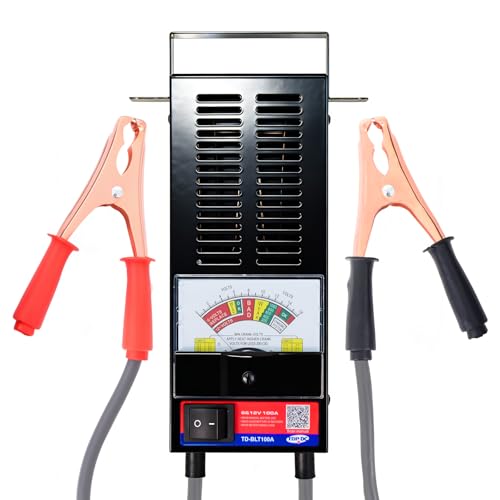
The TOPDC tester handles 6V and 12V batteries with a testing range of 100–1000 CCA. It includes heavy-duty alligator clips and color-coded connections for reliable setup. It supports 100A load testing for 12V systems, providing a practical snapshot of battery health under load.
Who it’s best for: budget-conscious buyers needing a portable, straightforward tester for common 12V automotive batteries. Why selected: solid value with essential load testing capabilities and clear indicator results.
Caution: does not list support for lithium or deep-cycle battery chemistries beyond the stated 6V/12V focus.
Acclope BT60 PRO Car Battery Tester

The BT60 PRO supports 6V, 12V, and 24V systems, testing batteries from 2Ah to 120Ah. It provides SOH, SOC, voltage, resistance, and ripple analysis, along with cranking and charging waveform diagnostics. This makes it suitable for broader diagnostics in both consumer and professional settings, including motorcycles, cars, and boats.
Who it’s best for: professionals and DIYers needing deeper diagnostic data and multi-chemistry support. Why selected: high precision data and comprehensive testing functions help identify early battery and alternator issues.
Limitation: advanced features may require more user training relative to basic testers.
VDIAGTOOL BT500 Battery Load Tester

The BT500 is an all-in-one diagnostic tool for 6V, 12V, and 24V batteries, testing regular flooded, AGM flat plate, AGM spiral, GEL, and EFB chemistries. It also analyzes cranking and charging systems to determine whether the battery, alternator, or starting system is at fault. Its 99.99% accuracy claims reflect a sophisticated algorithmic approach to battery health assessment.
Who it’s best for: professional technicians and fleet operators who need reliable alternator and charging system analysis. Why selected: combined battery and charging system diagnostics reduce guesswork on no-start issues.
Caution: the interface and features may feel complex to new users; some learners may benefit from a quick-start guide.
TAKEWELL LCD Battery Tester

The TAKEWELL LCD Battery Tester provides immediate capacity display for SRAM batteries and serves as a compact, portable tester for simple checks on the go. Its straightforward display makes it easy to gauge battery state without complex charts or graphs.
Who it’s best for: travelers and users who primarily handle SRAM batteries or smaller devices. Why selected: fast, visible results in a compact form factor.
Limitation: not designed for car or heavy-duty lead-acid batteries; best used for SRAM and similar types.
Buying Guide: Key Considerations for Battery Cycling Test Equipment
- Battery types and voltages: Confirm the device supports your battery chemistries (lead-acid, AGM, GEL, EFB, lithium) and the voltage range (6V, 12V, 24V). This ensures accurate diagnostics for your fleet or personal use.
- Testing capabilities: Look for SOH, SOC, voltage, resistance, and cranking/charging analysis. If you routinely test alternators or generators, choose a model with charging system tests.
- Load testing vs. no-load testing: Load testers simulate real-world draw to assess how well a battery can perform under starting conditions. This is crucial for predicting start reliability in cold weather.
- Ease of use vs. depth of data: Simpler units are quick and intuitive, while advanced models offer deep diagnostics like waveform analysis and ripple measurements. Balance your needs with your technical comfort level.
- Portability and form factor: For frequent field use, a compact or handheld tester with a durable kit (clips, probes) is preferable. For a shop, a larger, more capable unit may be acceptable.
- Connectivity and reports: Some units provide cloud or USB data export, helpful for tracking battery health over time or sharing diagnostics with a fleet manager.
- Limitations and safety: Check the device’s safe operating procedures, whether it requires powering on with proper test connections, and any cautions about battery type limitations.
FAQ
- What is the difference between a battery tester and a load tester?
A battery tester measures static parameters like voltage and SOH/SOC, while a load tester simulates real-world electrical demand to evaluate cranking performance and charging system capability.
- Can these testers handle lithium or deep-cycle batteries?
Some models support multiple chemistries, but many are designed primarily for lead-acid, AGM, or GEL. Always verify battery type compatibility in the product specs.
- Why would I need a tester with waveform or ripple analysis?
Waveform and ripple analysis help detect alternator and charging system issues that simple voltage readings may miss, improving diagnosis accuracy.
- Is a portable tester enough for fleet maintenance?
For basic battery health checks and regular maintenance, a portable tester works well. For fleet operations, a higher-end unit with data logging and multi-vehicle support may be preferable.
- What should I look for when selecting a tester for 24V systems?
Ensure the device supports 24V operation, has appropriate CCA/Ah ranges, and offers reliable diagnostics for both batteries and charging systems at 24V.
- Are these testers safe to use without disconnecting the battery?
Most testers require proper attachment to the battery terminals; always follow the user manual for safe testing procedures to avoid short circuits or shocks.
Add a Comment