Answering the core buyer question: which AC/DC TIG welder best fits your aluminum projects and general welding needs? This guide highlights five versatile 6-in-1 to 5-in-1 machines that handle AC TIG, DC TIG, pulse modes, and stick welding. It explains who each model is best for, plus practical trade-offs to help you choose.
The following table summarizes the five selected machines, focusing on best uses, voltage capability, and standout features. Use it to compare at a glance and then read the in-depth sections for each product.
| Product | Best For | Voltage | Key Feature |
|---|---|---|---|
| Sunstac 250A AC/DC TIG Welder | Aluminum professionals and serious hobbyists | 110/220V | Pulse TIG, AC/DC, LCD display |
| YESWELDER 200A AC/DC TIG Welder | Compact, portable aluminum work | 110/220V | Large LED display, auto memory |
| Weldpro 200A AC/DC TIG Welder | Versatile multiprocess projects | 110/220V | 5-in-1: TIG, pulse TIG, stick |
| ARCCAPTAIN TIG Welder 200A | Precision aluminum and non-ferrous work | 110/220V | 7-in-1 with waveform options |
| AZZUNO AC/DC TIG Welder 200A | Advanced aluminum welding with dialed control | 110/220V | 6-in-1, dense digital controls |
Sunstac 250A AC/DC TIG Welder

Best for: Aluminum-focused fabrication and professional hobbyists who need reliable AC TIG and DC TIG with pulse options. The Sunstac model supports high-frequency AC and DC with a 250A output and dual voltage (110/220V), making it flexible for shop walls or field sites. The LCD digital screen improves readability in helmets-on conditions, aiding precise parameter control.
Why selected: It combines robust aluminum capabilities with multiple TIG modes, including AC SPOT and pulse settings, enabling cleaner aluminum welds and fewer defects in thin materials. The built-in dual voltage expands compatibility with common power supplies.
Limitation: Real-world usability depends on the correctness of parameter setup; ensure you optimize AC balance and frequency for aluminum thickness to prevent burn-through on very thin pieces.
YESWELDER 200A AC/DC TIG Welder

Best for: Portable and user-friendly setups for beginners or hobbyists needing strong aluminum welding capabilities with a large display. The 200A output handles a range of metals, and auto-sensing dual voltage ensures straightforward operation without manual trips between 110V and 220V.
Why selected: The large LED display simplifies parameter checks, and features like Hot Start reduce electrode sticking. Its balance of weight (about 7.5 kg) and performance suits small workshops or mobile setups where quick setup matters.
Caution: While convenient, the device may require careful calibration when switching voltages to avoid short-term arc start fluctuations on delicate materials.
Weldpro 200A AC/DC TIG Welder
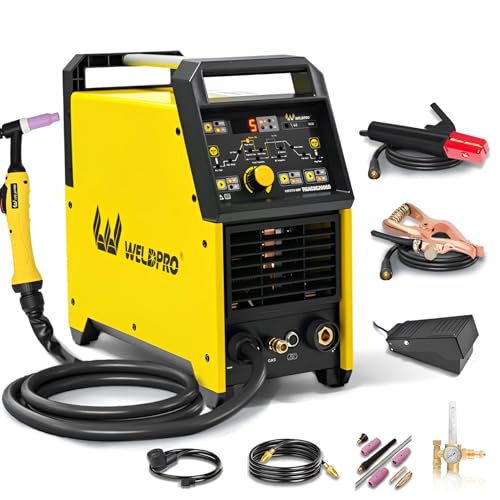
Best for: Welders seeking a 5-in-1 solution that balances TIG capability with stick welding for thicker metals. The dual voltage 110V/220V input is ideal for workshops that share power with other equipment.
Why selected: It offers fully adjustable AC balance, frequency, and pulse settings for precision aluminum work, plus a high-frequency non-contact arc start for reliable ignition. The 5-in-1 functionality expands project options beyond TIG alone.
Limitation: The pedal and torch accessories may need separate purchase depending on the kit; verify included items before buying for full flexibility.
ARCCAPTAIN TIG Welder 200Amp

Best for: Welders needing multi-waveform control and 7-in-1 versatility for aluminum and other non-ferrous metals. It suits intermediate to advanced users who want precise waveform adjustments to minimize heat input and oxide formation.
Why selected: It supports square and triangular waveforms, which helps reduce heat input and control oxide layers during aluminum welding. The large LED display aids readability in busy shops.
Warning: The advanced waveform options can be challenging for newcomers; start with basic modes and incrementally introduce pulse settings to avoid overheating thin sections.
AZZUNO AC/DC TIG Welder 200A

Best for: Users seeking a well-rounded 6-in-1 tool with precise digital control for aluminum and steel. Its advanced pulse control and 2T/4T modes make it suitable for more controlled long welds and intricate joints.
Why selected: The 6-in-1 design covers TIG, pulse TIG, spot TIG, and stick, enabling a broad range of applications. The MCU digital control system allows fine-tuning of pre-flow, post-flow, AC balance, and pulse frequency for tailored welds.
Limitation: The included pedal compatibility is not universal; verify pedal compatibility if you plan to use pedal-controlled setups for high-precision work.
Buying Guide: Key Purchase Considerations
- Welding type and materials: If you mostly weld aluminum, prioritize machines with robust AC TIG performance, adjustable AC balance, and HF start. For mixed metal work, a 5-in-1 or 6-in-1 model offers flexibility.
- Voltage and portability: Dual-voltage (110V/220V) is essential for home shops and mobile jobs. Consider weight and built-in handles if you move between sites.
- Display and controls: A clear LCD/LED display helps with parameter setup, especially during long sessions or when wearing a helmet.
- Waveforms and control options: Pulse, square, and triangular waveforms influence heat input and oxide removal on aluminum. More control options are beneficial for seasoned welders but may complicate beginners.
- Ease of use: Features like hot start, auto memory, and non-touch arc starting reduce errors and tungsten wear, improving overall weld quality.
- Accessories and compatibility: Check what comes with the package (torches, foot pedals, regulators). Some kits require separate purchases for full functionality.
Frequently Asked Questions
- What does AC TIG enable on aluminum?
– AC TIG allows cleaning oxide and penetrating aluminum alloys more effectively, which reduces porosity and improves bead appearance on aluminum. - Is dual-voltage important for beginners?
– Yes. It enables plugging into standard outlets and more powerful sites without a separate transformer, reducing power constraints. - Should I choose a 5-in-1 or 6-in-1 welder?
– Choose 6-in-1 if you need more process options like spot and stick in addition to TIG. If you primarily weld TIG, a 5-in-1 may suffice. - Do these welders require a foot pedal?
– Some models include a foot pedal, others offer pedal compatibility as an option. Pedals can improve control for long, precise passes. - What is the significance of pulse control?
– Pulse reduces heat input, helping manage distortion and allowing welds on thin materials without burn-through. - Can these welders handle stainless steel?
– Most models support stainless steel via DC TIG or pulse modes; verify the specific model’s capabilities for your thickness and alloy.
Add a Comment