When lives are on the line, dependable confined space rescue gear is a necessity. This guide highlights top-rated rescue tripods and related accessories designed for reliability, strong load capacities, and user-friendly operation. From compact 1200 lbs kits to heavy-duty 2600 lbs configurations, these selections cover municipal, industrial, and emergency response needs. Each option includes a robust winch, durable construction, and practical accessories to enhance safety and efficiency in confined spaces.
| Product | Winch Capacity | Leg Height | Cable |
|---|---|---|---|
| VEVOR Confined Space Tripod Kit (1800 lbs) | 1800 lbs | 7′ legs | 98′ cable |
| VEVOR Confined Space Tripod Kit (2600 lbs) | 2600 lbs | 8′ legs | 98′ cable |
| VEVOR Confined Space Tripod Kit (1200 lbs) | 1200 lbs | 7′ legs | 98′ cable |
| TRSMIMA Confined Space Tripod Kit | 1200 lbs | 7′ adjustable legs | 98′ cable |
| TROPOW Confined Space Tripod Kit | 1200 lbs | 48″ to 49″ adjustable height | 49.2′ cable |
These picks prioritize secure cable handling, quick release features, and portability. They are well-suited for rescue operations in sewers, manholes, and other tight environments, with attention to anti-rotation cables, self-locking devices, and included fall arresters. The selection below maps directly to real-world use cases, ensuring responders have reliable access to a range of capacities and configurations.
VEVOR Confined Space Tripod Kit (1800 lbs)

The 1800 lbs capacity tripod is designed for challenging rescues where heavier loads are anticipated. It features a Φ5 mm steel wire cable, a solid metal body, and secure connections for reliable operation. The anti-rotation cable enhances stability during ascent or descent, while the included 350 lbs full-body security harness and fall arrester provide essential protection. All components pack neatly into a durable storage bag for transport and on-site readiness.
VEVOR Confined Space Tripod Kit (2600 lbs)
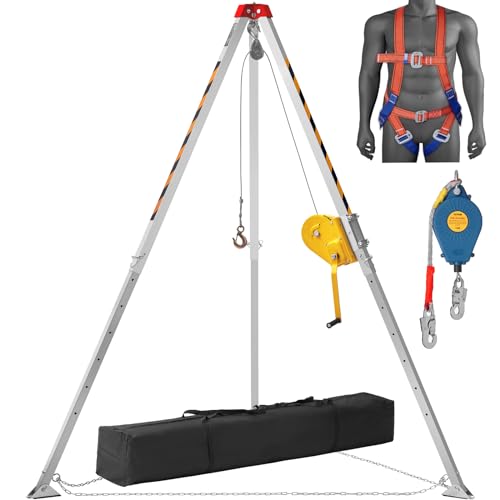
For high-demand environments, this 2600 lbs capacity tripod offers enhanced safety and strength. The Φ6 mm steel wire cable supports heavier loads, while the rugged one-piece molded design ensures durability in tough conditions. Like the 1800 lbs version, it includes a 350 lbs full-body harness and a fall arrester, all stored in a compact bag for mobility. This configuration is well-suited to municipal and industrial teams facing larger rescue scenarios.
VEVOR Confined Space Tripod Kit (1200 lbs)

This 1200 lbs option emphasizes portability with a lighter frame while maintaining reliable lifting performance. It features a 4 mm steel cable and a secure, self-contained design. Included safety gear, such as an efficient fall arrester, complements the kit to ensure a safe, on-the-go rescue setup. The compact profile makes it a practical choice for smaller teams and tighter sites.
TRSMIMA Confined Space Tripod Kit

TRSMIMA offers a complete 1200 lbs rescue tripod with 7′ adjustable legs and a 98′ cable. The kit includes a foldable tripod, fall arrester, and a carry bag. It’s designed for quick setup in emergency or municipal operations, with aluminum construction for lightweight handling and a self-locking winch to help secure loads during ascent or descent. The legs can adjust for uneven terrain, enhancing versatility in field conditions.
TROPOW Confined Space Tripod Kit

The TROPOW kit emphasizes a heavy-duty lifting capability with a 1200 lbs winch and a 49.2 ft self-retracting cable, plus adjustable legs for diverse site conditions. It features an automatic locking mechanism on the cable to prevent sudden descents, enhancing operator safety. The kit’s compact design and included storage bag support efficient field deployment in sewer, manhole, or utility rescues.
Buying Guide
Key considerations when selecting confined space rescue equipment include load capacity, cable length and type, leg height and adjustability, durability, and included safety accessories. A higher winch capacity accommodates heavier loads and more demanding scenarios, but portability and weight play a role in rapid deployment on-site. Look for self-locking or automatic locking cables to minimize risks during ascent and descent. Anti-rotation cables and corrosion-resistant materials improve reliability in harsh environments. Accessories like full-body harnesses and fall arresters add critical protection for rescuers and victims alike.
Other important aspects to compare:
– Leg design: 7’–8′ adjustable legs provide stability on uneven surfaces, while compact sizes save space in confined spaces.
– Cable management: Self-retracting cables and tangle-free storage reduce setup time and maintenance.
– Portability: Storage bags and lightweight alloys improve transport between sites.
– Safety certifications: Choose equipment that adheres to established safety standards and manufacturer guidelines for rescue operations.
When building a rescue kit, consider pairing a higher-capacity tripod with compatible retrieval devices (wristlets) when victim handling is expected. Routine inspection and maintenance of winches, cables, and pulleys are essential to ensure performance during emergencies. The products above offer a range of capacities and configurations designed to help teams tailor their equipment to the specifics of their work environments while maintaining a focus on safety and efficiency.
Add a Comment