The market offers a wide range of coating thickness gauges designed for automotive paint checks, metal finishing, and industrial coatings. This article highlights five leading options that balance accuracy, ease of use, and value. Each product is evaluated on substrate detection, measurement range, data handling, and user convenience to help you choose the right tool for used-car inspections, workshop tasks, or quality control.
| Product | Brand | Best For | Key Strength |
|---|---|---|---|
| Car Coating Thickness Meter | RDINSCOS | Used car buyers and automotive paint checks | Automatic ferrous/non-ferrous detection; portable |
| KAIWEETS Paint Thickness Gauge | KAIWEETS | Quick, precise factory-calibrated readings | Fast measurements; large rotatable display; data storage |
| Bonvoisin Ultrasonic Thickness Gauge | Bonvoisin | Industrial thickness and corrosion assessment | Wide range; data storage; calibration features |
| New Digital Coating Thickness (Dpofirs) | Dpofirs | Automotive coatings with dual-principle sensing | 1 µm resolution; multiple measurement units; zero/multi-point calibration |
| REED Instruments R7900 Ultrasonic Gauge | REED Instruments | General-purpose thickness on varied materials | Broad material compatibility; large display; memory |
Across these options, users can expect reliable ferrous and non-ferrous detection, clear displays, and robust data handling. Whether you’re inspecting a used car, evaluating coatings on pipelines, or conducting factory QA, these gauges provide essential non-destructive measurements without removing surfaces.
RDINSCOS Car Coating Thickness Meter
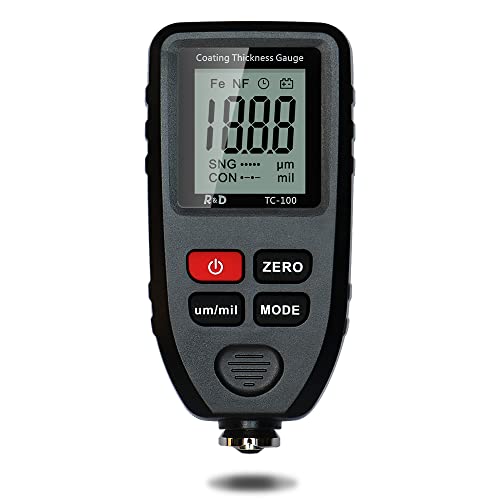
The RDINSCOS gauge uses dual technology to automatically recognize ferrous and non-ferrous substrates, enabling coating thickness measurements on steel and aluminum with minimal setup. It is especially useful for automotive paint inspections, powder coating checks, and evaluating metal surface finishes. The model is commonly employed for used-car inspections, anodized aluminum, bathroom fittings, and other metallic surfaces. It is designed primarily for metallic substrates and helps buyers identify hidden repairs by measuring each panel’s paint thickness. A practical tool for evaluating a car’s original coating before purchase.
REED Instruments R7800 Coating Gauge

This model from REED Instruments offers automatic detection of ferrous and non-ferrous substrates and features a color LCD display that is easy to read from multiple angles. The built-in portability makes it suitable for on-site automotive and metalwork inspections where quick, reliable readings are needed. The device is designed for straightforward operation, focusing on practical automotive and industrial measurement tasks.
KAIWEETS Paint Thickness Gauge

The KAIWEETS gauge delivers fast, reliable measurements with automatic substrate identification for ferrous and non-ferrous metals. It has a rotatable, backlit display for easy reading from any angle, with the ability to store up to 30 data sets. Alarm limits streamline assessments of coating normalcy, and auto power-off conserves battery life. This tool is well-suited for automotive shops and field inspections where speed and data tracking matter.
Bonvoisin Ultrasonic Thickness Gauge
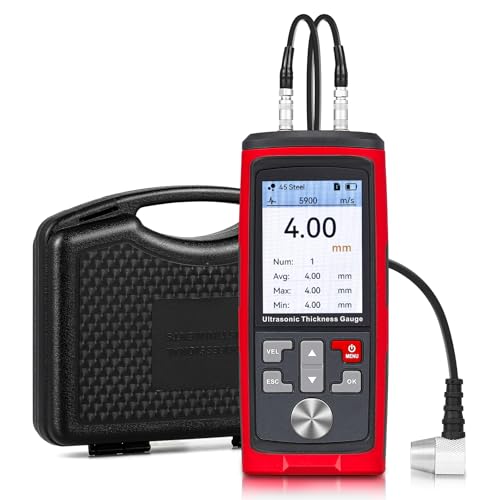
Bonvoisin’s gauge covers a broad range suitable for steel, copper, cast iron, plastics, glass, and more, with a high resolution and a low measurement error. It provides an adjustable sound speed, automatic shutdown, and data export potential via software. This model targets industrial users who need accurate thickness data across various materials and services, including corrosion assessment and quality control in manufacturing environments.
New Digital Coating Thickness (Dpofirs)

Dpofirs offers a dual-principle probe with magnetic induction and eddy current, automatically recognizing the substrate. It provides 1 µm resolution across a 0–2000 µm range, supporting measurements in micrometers, millimeters, and mils. The device includes zero and multi-point calibration, and stores measurement data for later review. It is aimed at automotive paints, coatings on steel, aluminum, and copper, and general non-destructive testing in professional settings.
REED Instruments R7900 Ultrasonic Gauge

The REED R7900 measures thickness across a broad range of materials, including metals, plastics, ceramics, composites, epoxies, and glass. Its internal memory stores up to 500 readings, and an adjustable alarm system aids monitoring of thickness thresholds. The large, backlit LCD display supports use in various lighting conditions, making it a versatile option for lab and field environments where multi-material thickness data is required.
Buying Guide: Key Purchase Considerations
When choosing a coating thickness gauge, consider substrate versatility, measurement range, and calibration options. For automotive use, prioritize automatic ferrous/non-ferrous detection, fast results, and compact form factors. For industrial or corrosion-focused tasks, look for wider measurement ranges, data storage capacity, and compatibility with multiple materials. Calibration features—zero point, multi-point, and factory presets—improve accuracy across substrates. A clear, rotatable or adjustable display helps readings in cramped or angled workspaces. Look for devices with data logging, export capabilities, and easy transfer to PCs or mobile devices for QA documentation. Battery life and auto power-off are practical considerations for field use. Finally, assess whether the tool includes accessory software or calibration blocks for precise, repeatable testing.
Substrate handling matters: some gauges excel on ferrous metals, others handle aluminum and non-ferrous materials better. For used-car inspections, a compact unit with automatic substrate detection and panel-by-panel thickness checks is valuable. In industrial settings, models with large data capacity, robust calibration options, and compatibility with sensors or PCs offer stronger long-term value. Always verify that the device supports your typical material mix and measurement units (µm, mils, mm) to ensure seamless reporting and traceability.
With these five options, readers can evaluate a range of trade-offs between portability, speed, and data management. Each instrument provides a non-destructive method to assess coating thickness, supporting informed decision-making in purchases, repairs, and quality control.
Add a Comment