Stand-on pallet trucks are designed for operators who need higher maneuverability in tight spaces while maintaining a compact footprint. This guide highlights five top options suited for different workloads—from heavy lifting in warehouses to quick, in-aisle transfers. It helps buyers choose based on capacity, reach, and ease of use. The table below summarizes each pick at a glance.
| Product | Brand | Capacity | Best for |
|---|---|---|---|
| Vestil EPT-2748-30 Steel Stand-On Electric Pallet Truck | Vestil | 3000 lbs | Compact reach in tight spaces |
| VEVOR Manual Pallet Jack 5500 lbs | VEVOR | 5500 lbs | Heavy-duty lifting in warehouses |
| Vestil PM5-2748-QL Quick Lift Pallet Truck | Vestil | 5500 lbs | Full-height lifts with easy handling |
| UNISOAR Industrial Duty Pallet Jack | UNISOAR | 6600 lbs | Heavy-duty, general-purpose use |
| VEVOR Full Electric Pallet Stacker | VEVOR | 3300 lbs | High stacking heights and tight spaces |
Buyer profiles: operators needing maximum agility in narrow aisles should favor electric or quick-lift models; facilities handling heavy loads benefit from higher capacities; mixed-use environments do well with versatile, dual-wheel or stacker options. This guide cites each model’s key strengths and a practical limitation to aid decision-making.
Vestil EPT-2748-30 Steel Stand-On Electric Pallet Truck

Features include a compact footprint suitable for tight areas, a long handle to reduce slouching during maneuvering, and extended battery life for continuous use. Best for operators who need to move pallets quickly in crowded warehouses or retail backrooms where space is at a premium.
Who it’s best for: small to mid-sized facilities needing an electric stand-on option that fits through narrow aisles. Why selected: its compact design and battery longevity support longer shifts with fewer interruptions.
Caution: Electric devices require regular charging and battery maintenance to avoid unexpected downtime.
VEVOR Pallet Jack, 5500 lbs Manual

Features include a 5500 lb (2.5T) capacity with 48 x 27-inch forks, a 7.1-inch lift height, and 7-inch dual wheels for a 180-degree turning radius. Best for heavy-duty loads in warehouses, supermarkets, and factories where power-assisted lifting isn’t required every move.
Who it’s best for: operations needing raw lifting strength without electric assist. Why selected: high capacity and maneuverability through narrow spaces with a good turning radius.
Caution: Manual jacks require more physical effort, particularly in long shifts or very heavy pallets.
Vestil PM5-2748-QL Quick Lift Pallet Truck
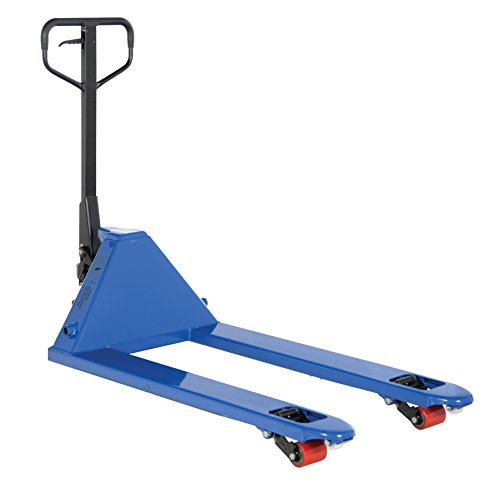
This unit reaches full height with five or six handle strokes even without a load and features reinforced triple-formed steel forks for strength plus a spring-loaded pump handle that raises forks for easy transport. Best for facilities that require quick, independent lifting to pallet heights before moving loads.
Who it’s best for: teams that perform frequent pallet staging and need fast lift without unloading pallets. Why selected: quick lift capability can save overall cycle time.
Caution: Heavier construction can mean higher effort to operate if not fully required for every move.
UNISOAR Industrial Duty Pallet Jack

It offers a 6600 lb capacity, 27″ x 48″ forks, a fingertip control with a safety loop handle, and dual PU wheels for durability. Best for general-purpose material handling in warehouses and manufacturing settings that demand high capacity with smoother operation.
Who it’s best for: teams needing a robust, medium- to heavy-load pallet truck for frequent use. Why selected: the high capacity and dual wheels support steady, reliable movement.
Caution: As a high-capacity manual model, consider operator fatigue and the need for proper technique on heavy pallets.
VEVOR Full Electric Pallet Stacker

Powerful performance with a 2.2 kW motor, lifting up to 3300 lbs and adjustable forks (width 8.66-31.1 inches) plus a wide mast height range. This option excels in stacking tasks and tight spaces where reach and height are critical.
Who it’s best for: operations needing high-lift capability and adaptability for various pallet sizes. Why selected: strong lift height and adjustable fork width provide versatility in small and busy facilities.
Caution: Electric movers require attention to charging cycles and maintenance to ensure consistent performance over time.
Buying Guide
What capacity best fits your needs? Choose a model that comfortably exceeds your typical load. For frequent heavy lifts, prioritize higher rated jacks or stackers. If you perform many moves in narrow aisles, look for compact footprints and tight turning radii.
Should you pick electric or manual? Electric stand-ons provide faster, less tiring operation for long shifts. Manual jacks offer rugged simplicity and lower upfront costs but require more physical effort.
How important is lift height and fork width? Consider the tallest stacking height you’ll reach and the variety of pallet sizes. Adjustable forks and mast heights improve flexibility in mixed environments.
What maintenance considerations matter? Electric units require battery care and charging discipline. Manual jacks benefit from regular lubrication of wheels and joints to maximize lifespan.
Safety features to look for include a secure handle design, stable fork alignment, and proper braking/steering controls. Ensure operators receive training on correct lifting techniques to minimize strain and injury.
Frequently Asked Questions
- What is a stand-on pallet truck? A stand-on pallet truck is a pallet-moving device where the operator rides or stands on a platform or footrest, providing improved maneuverability in tight spaces compared to traditional sit-down or walk-behind models.
- How do I choose between electric and manual? If you move pallets frequently or over long shifts, an electric model reduces fatigue and speeds up tasks. For occasional use or tight budgets, a manual jack can be sufficient.
- What pallet sizes do these trucks handle? Most models listed accommodate standard pallet dimensions (roughly 40 x 48 inches or similar). Check fork length (commonly 27 x 48 inches) and fork width to ensure compatibility with your pallets.
- Is higher lift height always better? Not always. Higher lifts are beneficial for stacking and multi-level storage but add weight and mechanical complexity. Match height needs to your facility layout.
- What maintenance helps prolong life? For electric models, battery charging schedules and routine inspection of moving parts are key. For manual models, lubricate wheels, check forks for wear, and inspect hydraulic components if present.
- Do these tools require operator training? Yes. Proper training reduces injury risk and improves efficiency, especially when handling heavy pallets or operating in confined spaces.
Add a Comment