Answering the need for reliable, secure hydraulic connections, this guide highlights top hydraulic pipe fitting kits and fittings. Best for shop technicians, fabrication shops, and DIY enthusiasts building or repairing hydraulic systems, these selections emphasize durable materials, universal compatibility, and leak-free performance. The table below summarizes five strong options chosen for versatility and value.
| Product | Best For | Why It Stands Out |
|---|---|---|
| Racewill 12 Pack Hydraulic Hose Fittings: 1/2″ I.D. Hose x 1/2″ NPTF Male | General hydraulic hose work | 1/2″ NPTF male with protection cover; robust carbon steel; crimp design for secure, leak-resistant connections |
| Racewill 10 Pack Hydraulic Hose Fittings: 1/2″ NPSM Female x 1/2″ NPTF Male | Leak-free, secure hose joins | NPSM and NPTF sealing, high-temp and high-pressure tolerance; protection cover |
| Racewill 12 Pack Hydraulic Hose Fittings: 3/8″ I.D. Hose x 3/8″ NPTF Male | Compact hydraulic lines | 3/8″ I.D. fittings with crimp design; durable carbon steel; wide operating range |
| Racewill 12 Pack 1/2″ NPTF Hydraulic Hose Fittings, 3/8″ I.D. | Dual-fit hose systems | Combination of 3/8″ I.D. hose connections and 1/2″ NPTF male ends; reinforced stability |
| CEKER Hydraulic Coupler 1/4″ NPT ISO 7241-B | ISO-standard quick connects | ISO 7241-B compliant, self-sealing, high burst and working pressures; suitable for fast coupling |
Racewill 12 Pack Hydraulic Hose Fittings: 1/2″ I.D. Hose x 1/2″ NPTF Male

These fittings provide a straightforward, secure connection for 1/2″ I.D. hydraulic hoses. They use a 1/2″ NPTF external thread and are designed for fluid power systems and hydraulic applications. The carbon steel construction supports a wide temperature range from -65°F to 500°F, suitable for petroleum-based fluids, gasoline, fuel, and lubricating oils. A crimped, permanent connection minimizes leaks. Best for: general hydraulic hose work where a robust, crimped connection is required. Caution: ensure compatible hose prep and proper crimping tooling to avoid leaks.
Racewill 10 Pack Hydraulic Hose Fittings: 1/2″ NPSM Female x 1/2″ NPTF Male

These fittings pair 1/2″ NPSM female with 1/2″ NPTF male ends for secure, high-integrity connections. They are made of premium carbon steel, with heat and corrosion resistance suitable for industrial fluids. The dry-sealing cone thread and NPTF/NPSM design provide higher sealing and reliability, reducing the chance of leaks or loosening. Best for: systems requiring tight, leak-proof fittings with robust sealing. Caution: verify that NPSM female orientation matches your hose end for best performance.
Apache 39004276 3/8″ Male x 3/8″ Female Swivel

This swivel adapter provides a straightforward 3/8″ male to 3/8″ female connection, 1/32 restricted, suitable for compact hydraulic lines. While easy to use, note the product is manufactured in China and is best for setups needing quick swiveling joints to prevent hose kinks. Best for: tight-space manifolds where rotation improves hose routing. Caution: confirm thread standard matches your system to avoid incompatibility.
Racewill 12 Pack 1/2″ NPTF x 3/8″ I.D. Fittings
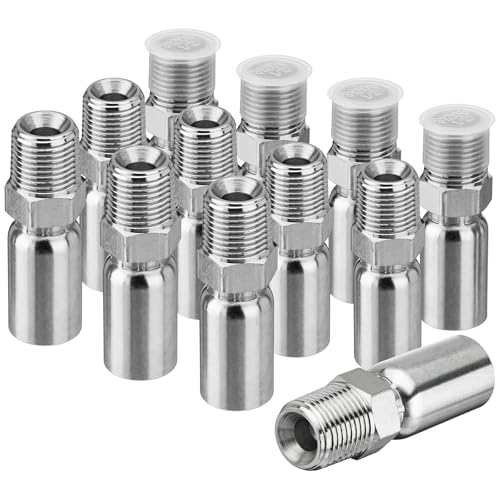
These fittings are designed for easy connection with 3/8″ I.D. hoses while offering a 1/2″ NPTF external thread. Constructed from premium carbon steel, they withstand a wide temperature range and are suitable for various industrial fluids. The permanent crimp design promotes secure connections to prevent leaks. Best for: systems balancing 3/8″ hose runs with 1/2″ NPTF male ports. Caution: verify hose inner diameter and thread match before crimping.
Buying Guide
What to consider when choosing hydraulic pipe fittings
Material durability matters. Carbon steel fittings offer strength and corrosion resistance for demanding environments, while ensuring compatibility with hydraulic fluids you plan to use. Temperature and pressure ratings indicate whether a fitting will endure your system’s operating conditions.
Thread type and seal design
NPTF and NPSM are common sealing designs. NPTF dry-sealing cones reduce leaks, while NPSM provides secure, non-leaking joints when paired correctly. Check the mating components to prevent mismatched threads.
Crimp vs. threaded connections
Crimp fittings require a dedicated crimping tool and hose end, offering high leak resistance and stable performance. Threaded fittings provide easier field assembly but may need thread sealant and careful torque to prevent leaks.
Compatibility with hose size
Match the hose inner diameter (I.D.) to the fitting’s connection size. Incorrect pairing can cause flow restrictions or weak joints. For example, 1/2″ I.D. hoses pair with 1/2″ NPTF or NPSM fittings, while 3/8″ I.D. hoses fit 3/8″ connections.
Protection and installation considerations
Fittings with protective covers reduce damage during storage and handling. Ensure proper crimping and alignment to prevent leaks. Consider the working environment, such as exposure to high temps or lubricants, when selecting materials.
Frequently Asked Questions
Q1: What is the difference between NPTF and NPSM fittings?
Answer: NPTF uses a dry-sealing cone thread designed to form a seal without a separate gasket, while NPSM uses straight threads for mechanical joining and relies on a separate seal. Both aim to prevent leaks, but one may suit your system’s sealing approach better.
Q2: Do I need a crimping tool for crimp fittings?
Answer: Yes. Crimp fittings rely on a dedicated crimping tool to ensure a secure, leak-free connection between hose and fitting.
Q3: Are these fittings suitable for high-temperature fluids?
Answer: Many are rated for broad temperature ranges (e.g., -65°F to 500°F), but verify the exact rating of each model before use with specific fluids.
Q4: Can I mix brands of fittings with my hoses?
Answer: Mixing brands is possible if thread sizes and sealing types match. Always confirm compatibility to avoid leaks or failures.
Q5: What should I check before purchasing?
Answer: Confirm hose ID, thread type, seal design, material durability, temperature and pressure ratings, and whether a crimping tool or adapters are required for your setup.
In summary, the selected fittings provide a mix of crimp-based, sealed, and swivel options to cover common hydraulic piping requirements. They are chosen for reliability, compatibility with standard hose sizes, and practical installation considerations in industrial and workshop environments.
Add a Comment