Answering the top question: when choosing a chain hoist or “chain fall” for heavy lifting, consider capacity, lifting height, brake reliability, and durability. This guide highlights five solid options across a range of capacities that are commonly used in garages, warehouses, and industrial settings. Best for contractors, shop mechanics, and facility managers who need secure, controlled lifting without powered equipment.
Summary table of selected products:
| Product | Capacity | Lift Height | Best For |
|---|---|---|---|
| VEVOR Hand Chain Hoist, 3 Ton (6600 lbs), Orange | 6600 lbs (3 T) | 20 ft | Heavy duty garage and construction tasks; best for higher-capacity needs |
| VEVOR Hand Chain Hoist, 2 Ton (4400 lbs), Orange | 4400 lbs (2 T) | 20 ft | Mid-range heavy lifting; good for mid-size equipment and vehicles |
| VEVOR Hand Chain Hoist, 1 Ton (2200 lbs), Red | 2200 lbs (1 T) | 20 ft | Standard shop tasks; versatile for engines and components |
| YATOINTO Chain Hoist 2 Ton, 20 ft | 4400 lbs (2 T) | 20 ft | Durable steel construction; reliable for shop and garage use |
| Jet 1-Ton Hand Chain Hoist, 20′ Lift | 2200 lbs (1 T) | 20 ft | Industrial environments needing robust mechanical design |
VEVOR Hand Chain Hoist, 3 Ton, 20 ft Lift

Capacity, durability, and secure lifting define this 3-ton hoist. It uses a dual pawl brake system to stabilize loads at the desired height and features an upgrade G80 galvanized chain for corrosion resistance in demanding environments. The 20 ft lifting height supports overhead positioning in garages, warehouses, and fabrication areas. This model is best for heavy-duty tasks where maximum capacity is the priority and where frequent high lifts are needed.
Best for: Shops and garages that regularly move heavy machines or equipment up to 3 tons. Choose this if you frequently lift heavy loads and require strong braking for precise control.
Caution: The higher capacity means more manual effort may be required at lower efficiency; ensure proper anchor points and clear paths to operate safely.
VEVOR Hand Chain Hoist, 2 Ton, 20 ft Lift
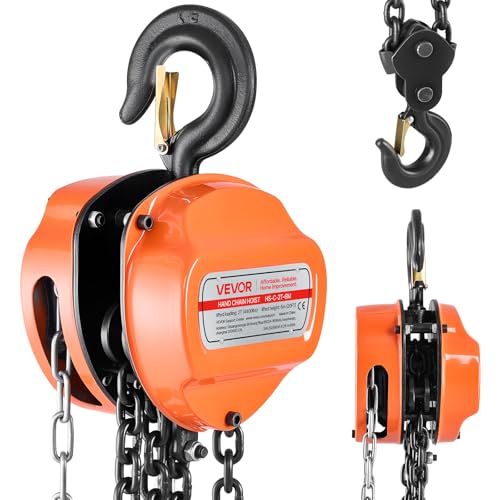
This 2-ton hoist balances capacity and ease of use for mid-size lifting tasks. The 20 ft lift height is suitable for vehicles, engines, and industrial components. With a dual pawl brake system and a deep groove chain design, it aims to enhance security and reduce chain slippage during lifts. It requires moderate effort to operate under full load.
Best for: Garages or small warehouses needing reliable 2-ton capacity with solid control and corrosion-resilient galvanized chain. Better for users who don’t require the highest maximum load but need robust performance.
Caution: Heavier users should plan for a longer pull when fully loaded; ensure a stable anchor and unobstructed lift path.
VEVOR Hand Chain Hoist, 1 Ton, 20 ft Lift, Red

This 1-ton hoist emphasizes smooth operation with ball bearings and a 20 ft lift height, making it versatile for shop tasks that require precise control. The mechanism uses a robust G70 galvanized chain and a reliable brake system to keep loads steady during lifting and lowering. It is lighter and easier to maneuver than higher-capacity models.
Best for: Small shops, auto repair bays, and hobbyist garages needing dependable 1-ton capacity with good maneuverability. Consider this if you work with engines and components within 1 ton range.
Caution: For very heavy items near 2 tons, this model may require additional mechanical advantage or care to avoid overloading.
YATOINTO Chain Hoist 2 Ton, 20 ft

Built with premium alloy steel and a corrosion-protected brake system, this 2-ton hoist emphasizes durability and precise operation. It uses heat-treated gears and a heavy-duty chain designed to resist wear in tough environments. The 360° rotating hook simplifies rigging around overhead structures.
Best for: Garages and workshops that require a sturdy 2-ton capacity with strong control and long-term durability. Favorable when frequent lifiting in tight spaces occurs and reliable chain handling matters.
Caution: Heavy use in harsh environments may warrant regular inspection of chain and hook components to ensure continued safety.
Jet 1-Ton Hand Chain Hoist, 20′ Lift

Industrial-rated design with 360-degree hook rotation and heat-treated load plates. The hoist uses case-hardened internal parts and corrosion resistance for demanding environments. Needle bearings support the load sheave to boost efficiency and smooth operation.
Best for: Industrial settings needing a reliable 1-ton hoist with durable construction and good resistance to harsh conditions. Choose this if you require rugged performance in tough shop environments.
Caution: As with all manual hoists, ensure proper training on rigging and load balance to prevent misalignment during lifts.
Buying Guide: Key Considerations for Choosing a Chain Hoist
- Capacity vs. workload: Match the hoist capacity to the heaviest load you expect to lift. Oversizing improves safety, but weight and effort rise with higher-capacity models.
- Lift height needs: Ensure the hoist offers sufficient travel height for overhead positioning in your workspace.
- Brake and control: Look for dual-pawl or mechanical load brakes for secure stopping and load control. A smooth release is also important for lowering.
- Chain material and protection: G80 galvanized chains resist corrosion and wear, extending service life in garages and warehouses.
- Durability: Steel construction, quality hooks, and heat-treated gears contribute to long-term performance, especially in harsh environments.
- Ease of use: Ball bearings and optimized chain paths reduce effort and chain wear during repetitive tasks.
- Mounting and rigging: Check hook rotation, swivel capabilities, and compatibility with common overhead anchors.
- Maintenance: Inspect chain, hooks, and brake components regularly, and follow safe-use practices to avoid overload.
Frequently Asked Questions
- What does 3-ton capacity mean for a chain hoist?
It means the maximum safe load the hoist can lift is 6,000 pounds. Do not exceed this limit for safety and equipment integrity. - Is a higher lift height always better?
Not necessarily. A higher lift height is useful for overhead positioning, but if most tasks are within a shorter range, a lower height with higher mechanical advantage can be more practical. - What is the advantage of a dual-pawl brake?
It provides more stable braking and improved load control during lifting and lowering, reducing the risk of sudden drops. - Should I choose galvanized chain or regular chain?
Galvanized (G80) chains offer better corrosion resistance and durability in industrial settings, extending service life in humid or dirty environments. - How do I determine the right hoist for my shop?
Consider the heaviest item you lift, the typical lift height, available mounting points, and whether you prioritize ease of use or maximum capacity. - Are manual hoists safer than powered hoists?
Both can be safe when used with proper training and rigging. Manual hoists offer simplicity and reliability where power sources are unavailable or undesirable.
Add a Comment