Find the right carbon fiber filament for your 3D printer and project needs. This guide highlights five strong choices, each best for specific use cases—from high-strength functional parts to precise, smooth finishes. Ideal buyers include hobbyists seeking durable parts, professionals prototyping tough components, and educators requiring reliable materials for classroom projects. Below is a concise buyer’s summary and a quick comparison table to help you decide at a glance.
| Product | Best For | Key Benefit | Diameter |
|---|---|---|---|
| Creality Carbon Fiber Filament | General-purpose carbon fiber printing | Low warping, uniform diameter | 1.75 mm |
| FLASHFORGE Carbon Fiber PETG | Rigid, durable parts with good dimensional stability | Stable, reliable printing; moisture resistant | 1.75 mm |
| ELEGOO Carbon Fiber PLA | Strong, easy-to-print PLA-CF parts | Excellent surface finish; good layer adhesion | 1.75 mm |
| Polymaker Fiberon PA612-CF15 | Strong, low-moisture-sensitive nylon parts | High rigidity with improved moisture tolerance | 1.75 mm |
| Polymaker Fiberon PA6-CF20 | High-strength, high-temperature nylon components | Excellent heat resistance and stiffness | 1.75 mm |
Note: All products listed offer 1.75 mm filament and are compatible with most FDM printers that support carbon-fiber reinforced materials. When selecting, consider print temperature range, nozzle material (wear-resistant steel recommended for CF filaments), and enclosure needs for best results.
Creality Carbon Fiber Filament 1.75mm

Creality’s carbon fiber filament emphasizes low shrinkage and reduced warping, helping users achieve consistent layer lines and reliable results on 3D prints that demand precision. It is described as easy to feed with a smooth flow, reducing nozzle plugging risks. Best for hobbyists and artists who want durable, clean prints without frequent calibration. A limitation is that performance can depend on printer setup and the nozzle wear caused by carbon fibers.
- High print quality with low shrinkage
- Uniform diameter for smooth feeding
- Carbon material offers weather and chemical resistance
FLASHFORGE Carbon Fiber PETG Filament

FLASHFORGE PETG-CF blends carbon fiber reinforcement with PETG to deliver strong parts with improved dimensional stability. It is well-suited for parts like frames, drone components, and tools where rigidity matters. The filament is dried and vacuum-sealed to minimize moisture-related issues, making it a reliable choice for users prioritizing consistent prints. Cautions include ensuring proper drying and using wear-resistant nozzles due to carbon fiber content.
- Enhanced rigidity and temperature resistance
- Stable, precise prints with minimal warping
- Desiccated packaging to protect moisture-sensitive material
ELEGOO Carbon Fiber PLA Filament
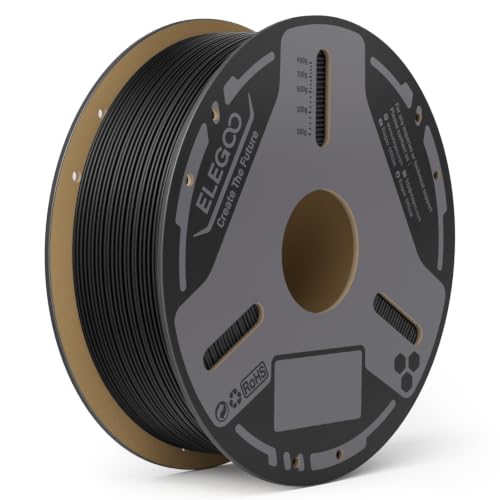
ELEGOO’s Carbon Fiber PLA-CF combines the ease of PLA with carbon fiber reinforcement for added stiffness and strength. It emphasizes better layer adhesion and smoother surfaces, making it a solid choice for functional components and quick prototypes. It is best for users who want PLA-like printability with enhanced mechanical properties, while noting that carbon fiber can increase nozzle wear and may require a hardened nozzle for long-term use.
- Superior mechanical properties with good surface finish
- Better layer adhesion for durable parts
- Machine-wound spool reduces tangling; precise diameter
Polymaker Fiberon PA612-CF15

Fiberon PA612-CF15 is a carbon fiber reinforced nylon filament designed for high-speed printing and durable outputs. It’s positioned for industrial tooling, automotive parts, and end-use components where stiffness and toughness matter. It offers lower moisture sensitivity than some nylon variants, reducing print failures due to humidity. A caveat is that nylon-based CF filaments may require higher printing temperatures and careful printer calibration to avoid warping.
- Strong, low moisture sensitivity
- Good first-layer adhesion and minimal jams
- Wide application range, including industrial parts
Polymaker Fiberon PA6-CF20
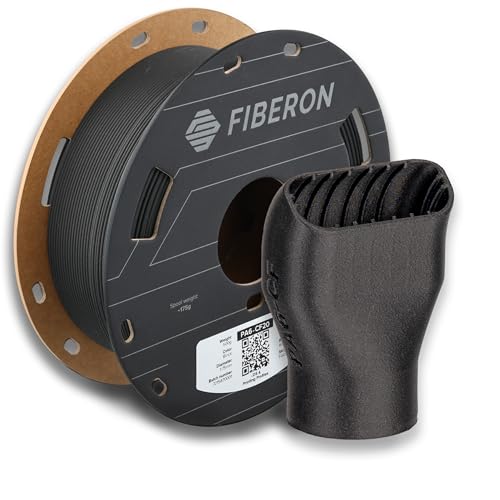
PA6-CF20 combines 80% nylon with 20% chopped carbon fibers to deliver exceptional stiffness and heat resistance. It is suited for torsional and high-load parts such as brackets, gears, and drone frames where durability is critical. It thrives in applications requiring strong mechanical performance and higher temperature tolerance. A limitation is that nylon-based CF filaments often demand controlled environments and hardened nozzle usage for longer print life.
- Very stiff and heat resistant
- Excellent layer adhesion and durability
- Suitable for high-stress, high-temperature parts
Buying Guide: Key Considerations for Carbon Fiber Filament
Material selection should align with your printer capabilities and project goals. Consider the following when choosing CF filaments:
- Printer compatibility: Ensure your extruder and nozzle can handle reinforced filaments. Hardened steel nozzles are recommended for carbon fiber blends.
- Diameter and tolerance: Most CF filaments are 1.75 mm with tight tolerances to reduce clogs and improve print reliability.
- Moisture sensitivity: Many CF filaments are hygroscopic. Drying and proper storage extend filament life and print quality.
- Mechanical properties: Nylon-based CF filaments offer higher strength and temperature resistance, while CF-PLA and CF-PETG balance ease of printing with toughness.
- Print settings: Expect higher printing temperatures and possibly slower speeds to optimize layer adhesion and surface finish. Enclosures help manage warping and thermal stability.
FAQ
- Q: Can I use standard nozzles with carbon fiber filaments? A: Use wear-resistant or hardened steel nozzles to withstand carbon fibers and reduce wear.
- Q: Do CF filaments warp more than regular PLA or PETG? A: Some CF blends can warp less than pure ABS but may require enclosure and temperature control for the best results.
- Q: Are CF filaments more brittle? A: CF reinforcement can increase rigidity; however, printing parameters greatly influence impact resistance and ductility.
- Q: Is drying CF filaments essential? A: For moisture-sensitive blends like nylon-based CF, drying improves print quality and reduces steaming or bubbling.
- Q: Which CF filament is best for high-load parts? A: Nylon-based CF filaments (like PA6-CF20 or PA612-CF15) generally offer higher toughness and heat resistance than PLA-based CF blends.
- Q: Do CF filaments require post-processing? A: Some parts benefit from light sanding or coating for improved surface finish and wear resistance.
Add a Comment