Answering the need for reliable submersible vertical turbine pumps, this guide highlights top models for home basements, busy drain tasks, and groundwater transfer. These pumps excel for homeowners, contractors, and small farms where auto operation and debris tolerance matter. Below, five models are compared on power, head, flow, and ease of use to help you pick the right pump for your water-removal job. A quick summary table follows the intro for fast scanning.
| Product | Power | Max Flow | Max Head | |
|---|---|---|---|---|
| LEO Sump Pump Submersible (Blue) | 1/3 HP | 2510 GPH | 26 ft | |
| LEO Sump Pump Submersible (Sky Blue) | 1/2 HP | 2980 GPH | 28 ft | |
| Deep Well Submersible Pump (HuaShuani) | 0.5 HP | 16 GPM | 216 ft | |
| BOMGIE 1/2 HP Sump Pump | 1/2 HP | 2980 GPH | 28 ft |
LEO Sump Pump Submersible Vertical Float Switch (Blue)

Power: 1/3 HP. This model can move up to 2510 gallons per hour and handles drains efficiently. It offers a 22 ft immersion depth and a 26 ft head. A 10 ft power cord provides flexible placement. The vertical float switch enables automatic operation as water rises or falls, reducing the need for manual control. A top suction strainer minimizes air locks and debris, helping the pump run consistently in smaller pumping volumes. Best for small basements, utility rooms, and tight spaces where automatic control is valued.
Who it’s best for: homeowners with compact sump pits who want automatic operation and debris tolerance in a lightweight unit.
What to watch: Lower max head than its 1/2 HP sibling; suitable for moderate drainage tasks rather than high-head scenarios.
LEO Submersible Sump Pump (Sky Blue) With Float Switch
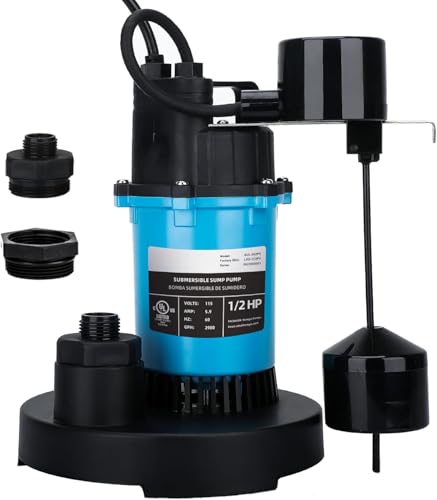
Power: 1/2 HP. Delivers up to 2980 GPH, with a 22 ft immersion depth and 28 ft head. The vertical float switch provides automatic on/off cycling as water levels change, while the top suction design helps prevent air locks and debris buildup. Its round, stable chassis and widened turbine channel enable effective operation in narrow pumping environments. This model is better for larger basements or spaces requiring higher flow without complicating installation.
Who it’s best for: users needing higher flow and deeper pumping potential in a compact form factor.
What to watch: Higher flow can require more power; ensure your electrical circuit can handle it.
Deep Well Submersible Pump (HuaShuani)

Power: 0.5 HP with a 16 GPM flow rate. Designed for deep-well water extraction, irrigation, and other transfer needs with a 1″ outlet and compatibility with 3″ OD pipe. It includes a 33 ft cable, enabling pumping from depths up to 216 ft. This pump is best for groundwater extraction and long-reach pumping tasks where submersible operation at depth is required.
Who it’s best for: professionals and homeowners needing depth-enabled pumping for wells or deep groundwater.
What to watch: Flow rate is lower than high-capacity sump pumps; use for deep source pumping rather than rapid surface drainage.
BOMGIE 1/2HP Sump Pump (Vertical Float, 2980GPH)

Power: 1/2 HP with a maximum flow of 2980 GPH. It features a vertical float switch for automatic operation and a 10 ft power cord for flexible placement. The top suction design helps prevent air locks and debris, and a round, stable chassis with a widened turbine flow channel supports pumping in narrow environments. Best for high-flow basement drains, pool draining, and other quick-water-removal tasks.
Who it’s best for: users needing robust, high-flow performance with automatic operation.
What to watch: Ensure electrical capacity matches the pump’s power needs; higher flow requires sturdy wiring.
Buying Guide: Key Purchase Considerations
What is a submersible vertical turbine pump and when should you buy one?
A submersible vertical turbine pump is designed to operate underwater, pushing water to a higher point or out of a drainage area. It is ideal for basements, crawl spaces, wells, and irrigation where debris tolerance and auto operation help reduce manual intervention.
How to choose by power and head
- Power (HP): Higher horsepower often means more water per hour and better performance for larger tasks. Choose 1/2 HP for larger drainage or deeper wells, and 1/3 HP for smaller spaces.
- Flow rate (GPH or GPM): Higher flow moves more water quickly. Match the rate to the size of the area and the urgency of drainage.
- Head: The maximum head determines how high the water can be pumped. If your drainage point is far above the source or requires elevation, pick a pump with a higher head.
Automation, float switches, and debris handling
- Vertical float switches provide auto start/stop, reducing manual monitoring. This is helpful for unattended basements and wells.
- Top suction and debris filters prevent clogs, important when draining dirty or debris-laden water.
Durability and installation considerations
- Immersion depth and construction materials affect long-term reliability in wet environments. Stainless steel components and robust housings offer better longevity in challenging conditions.
- Cord length and outlet size matter for installation flexibility. Ensure the power cord and electrical setup fit your location.
Best-practice comparisons
- Best for compact pits: LEO Blue model with a 1/3 HP and a 26 ft head, ideal for small spaces with automatic operation.
- Best overall high flow: LEO Sky Blue and BOMGIE models both deliver up to 2980 GPH and 28 ft head, suitable for larger or faster drainage jobs.
- Best for deep wells: HuaShuani Deep Well pump, with 216 ft pumping depth and 16 GPM, suited for groundwater extraction rather than surface drainage.
FAQ
- Q: What is the advantage of a vertical float switch? A: It enables automatic on/off based on water level, reducing manual monitoring.
- Q: Can I use these pumps for dirty water? A: Yes, many models are designed to handle clean and dirty water, though debris tolerance varies by unit.
- Q: How do I choose between 1/3 HP and 1/2 HP? A: Consider drainage volume, required head, and space. Higher HP supports higher flow and head but may require more power supply.
- Q: What should I check before installation? A: Check immersion depth, head requirement, cord length, and whether the outlet size matches your piping.
- Q: Are these pumps suitable for wells? A: Some models can handle deep pumping, but confirm pipe size, depth capabilities, and electrical safety for well use.
- Q: Do these pumps require maintenance? A: Regular cleaning of the top suction and float switch reduces clogs and prolongs life.
Add a Comment