Answering the search for reliable, automated powder filling, this guide highlights compact machines designed for powders and small granules. These options suit small businesses, home-based food producers, hobbyists, and workshops needing consistent fill weights. Below, five models are compared, with clear criteria to help choose the right fit for your product type and production pace. A quick summary table follows to help you compare at a glance.
| Model | Best For | Fill Range | Speed | Notes |
|---|---|---|---|---|
| Small batches, powders | 1–100 g | 8–16 packs/min | High precision; compact | |
| Medium batches, granules | 10–500 g | 10–12 packs/min | Strong for larger weights | |
| Home kitchens, DIY shops | Depends on setting | 3x manual speed | LED display; infrared/foot control | |
| Versatile powders and seeds | 1–200 g | Consistent dual-vibration | Intelligent control panel | |
| Glitter, flour, dry powders | 1–100 g | Automatic weighing | Precision 0.3 g |
TREESNAIL 1-100g Powder Filling Machine
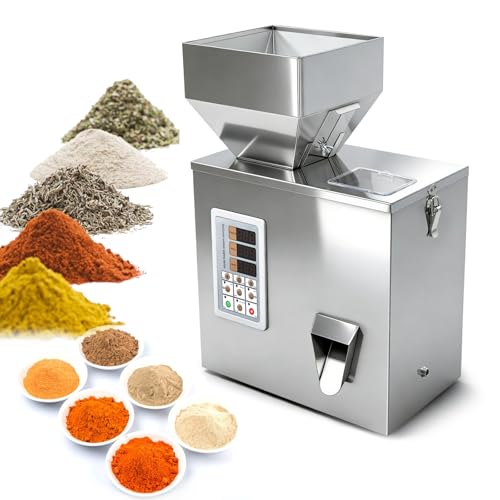
Best for: small-batch operations and home use. This model handles dry powders and small granules with high weighing accuracy and a vibration-assisted feeder for stable flow. It excels with spices, instant drink mixes, coffee powder, and flour. Not ideal for loose tea or irregular shapes.
- Wide application: powder and granule materials like spices, coffee powder, flour, grains, and pet foods.
- High accuracy: weighing ±1–2% depending on material.
- Fast filling: 8–16 packs per minute depending on weight settings.
Best for buyers needing a compact, automatic filler that balances fast throughput with precise fill weights in small batches. A potential limitation is incompatibility with irregular or loose-tea materials.
TREESNAIL 5-500g Powder Filling Machine

Best for: small businesses that need heavier granules or larger powder portions. This model supports 10–12 packs per minute and handles a wider weight range than the 1–100 g variant, making it suitable for flour, grains, or larger spice blends.
- Wide application: similar dry powders and granules as the 1–100 g model.
- High accuracy: ±1–2% depending on material.
- Filling speed: 10–12 packs per minute.
Choose this if your products demand larger fill weights without sacrificing automatic weighing. Limitation: slightly larger footprint and higher starting weight than the smaller unit.
Hanchen Smart Digital Powder Filling Machine

Best for: home and small workshop environments needing hands-free operation and space efficiency. It features a LED display, infrared or foot pedal control, and a compact form factor for countertop use.
- Smart digital control: precise measurements on a user-friendly LED panel.
- Faster than manual filling: reduces hand-scooping time.
- Space-saving design: compact, versatile for small setups.
Caution: Not suitable for poorly mobile powders like matcha or oversized flakes; ensure product consistency for best results.
VEVOR Powder Filling Machine

Best for: users seeking intelligent control and broad material compatibility. The dual-stage vibration motor improves discharge and minimizes leftovers, supporting powders, seeds, grains, and tea leaves with fill weights from 1 g to 200 g.
- Accurate filling: ±2 g typical, material-dependent.
- Intelligent control panel: easy weight and speed adjustments for different materials.
- Versatile fill range: handles powders, tea leaves, and grains.
Limitation: may require setup adjustments for very fine powders to prevent clumping; verify material suitability before use.
Fanlocn 1-100G Powder Filler

Best for: glitter, flour, and dry powders requiring precise 1–100 g fills. This model emphasizes fine control with 0.3 g accuracy and automatic weighing and filling functions.
- Range: 1–100 g; accuracy: 0.3 g.
- Automatic weighing and filling with counting function.
- Control options include sensor induction and foot pedal.
Limitation: not ideal for wet powders or irregular particle shapes; ensure material compatibility with the round hopper design.
Fanlocn 1-200G Powder Filler

Best for: users needing a larger fill cap while maintaining automatic weighing and counting. The 1–200 g range suits mid-range powders like flour blends or seasoning mixes.
- Weight range: 1–200 g; accuracy: ±0.3 g (material dependent).
- Three working modes: induction, foot pedal, automatic discharge.
- Automatic counting for batch tracking.
Limitation: larger weight range may be less cost-effective for tiny powders; verify your product weight distribution before purchase.
Jiabailie Powder Filling Machine

Best for: professional-grade powder packaging with fast cycle times and adjustable control. Supports 1–100 g ranges with intelligent dispensing and infrared sensing for hands-free operation.
- Commercial-grade construction in stainless steel.
- High-speed weighing with ±0.2 g accuracy (material dependent).
- Intelligent adjustable control with infrared sensor.
Limitation: higher-end unit with more complex setup; ensure staff are trained for operation and maintenance.
Buying Guide: Key Purchase Considerations
- What material will you fill? Consider powders vs. granules, moisture content, and static tendencies. Some machines handle fine, free-flowing powders better than irregular shapes.
- Fill weight accuracy vs. speed. Higher accuracy often means slower throughput. Define your target range and choose accordingly.
- Power and footprint. Check voltage (110V is common in the US) and the machine’s size to fit your workspace.
- Control methods. LED touch panels, infrared sensors, and foot pedals offer different workflows. Pick one that suits your operations and safety needs.
- Maintenance and materials. Stainless steel bodies resist corrosion; consider ease of cleaning for food-grade applications.
- Future scalability. If you anticipate growth, select a model with a wider weight range or multiple-dose capabilities.
Frequently Asked Questions
- What is the typical fill precision for these machines?
Most models target ±0.2–2 g depending on weight range and material. - Can these machines handle moisture-rich powders?
Some are better suited for dry powders; check material compatibility and any recommended coatings or liners. - Do these devices require special training?
Basic operation is straightforward, but recommended for models with intelligent controls and multiple modes. - Is a powered industrial version necessary for home use?
For hobbyists and small shops, compact units with 1–200 g ranges are usually sufficient. - Can I mix powders with different flow characteristics?
Inconsistent flow may affect accuracy; consider individual feeders or pre-mixing strategies for best results.
Add a Comment