Answering the needs of concrete testing professionals, this guide highlights five reliable cylinder mold options for creating uniform concrete samples. These molds are chosen for durability, measurement precision, and ease of specimen removal. Best for: researchers and field technicians needing consistent, repeatable cylinders for compressive strength testing, quality control, or construction materials research. The quick comparison below helps identify which mold fits specific lab or job-site workflows.
| Product | Brand | Best For |
|---|---|---|
| 4x8in Steel Concrete Cylinder Mold | Gilson Company, Inc. | Rugged steel molds with rust-resistant parts; easy specimen removal |
| Yantra 1x Laboratory Testing Concrete Test Cylindrical Mould | Yantra | Split-mold design for quick assembly and precise internal dimensions |
| 3x6in Cast-Iron Concrete Cylinder Mold | Gilson Company, Inc. | Re-usable, dimensionally precise, reinforced for rugged use |
| Tamping (Puddling) Rod | Materro | Used alongside molds to compact concrete for uniform density |
| Concrete Slump Test Kit with Tamping Rod | Quality Engineering | Complete slump testing setup for workability alongside cylinders |
4x8in Steel Concrete Cylinder Mold

Features include rugged steel construction, plated parts for rust resistance, and easy specimen removal. Best for: labs or field crews needing durable, reusable molds that withstand repeated use and provide clean cylinder demoulding. Better for long-term projects requiring frequent sampling. Caution: ensure proper lubrication and release agents to maximize ease of demolding in busy environments.
Yantra 1x Laboratory Testing Concrete Test Cylindrical Mold

Features note that the mold is split vertically into two parts with tight tolerances: mean internal diameter within +0.2 mm and height within +1 mm; ends machined to +0.05. Best for: users who need a split-mold design to speed assembly and ensure precise dimensions for accurate compressive strength results. Choose this if you prioritize consistent internal diameter across samples. Caution: verify dimensions against your testing standard before use.
3x6in Cast-Iron Concrete Cylinder Mold

Features include re-use-ready construction, reinforced ribs to resist deformation, and machining for exact dimensions. Best for: projects requiring higher durability and repeated reuse with tight tolerances. Better for long-term lab or field programs that test multiple batches. Caution: heavier molds may require more handling effort and storage space.
Tamping (Puddling) Rod

Best for: pairing with cylinders to compact concrete during filling to minimize air voids and improve sample uniformity. Limitation: data shows basic use; ensure rod length and diameter match your mold sizes and testing protocol for consistent workability results.
Concrete Slump Test Kit with Tamping Rod
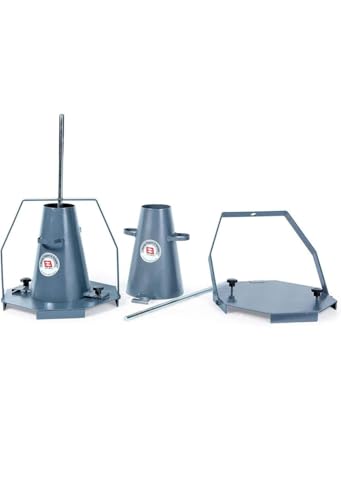
Features include a durable mild steel slump cone, tamping rod (16 mm x 600 mm), and a base plate for testing. Best for: teams performing standard slump tests to assess workability alongside cylinder preparation. Caution: ensure proper cone cleaning and drying between tests to prevent cross-contamination of results.
Buying Guide
What mold size should I choose? Consider standard specimen sizes (e.g., 100 mm or 150 mm diameter cylinders) that align with your testing standards and aggregates. Heavier 3x6in cast-iron options offer durability, while split Yantra designs speed setup and improve dimensional control.
Material and durability matter. Steel molds resist wear to extend service life, while iron molds offer rigidity and precise machining. Rust resistance and plated components reduce maintenance. Select based on how frequently you test and the environment (lab vs. field).
Demolding and ease of use. Molds with simple demolding reduce handling time and sample damage. Look for compatibility with common release agents and smooth internal finishes to minimize cylinder defects.
Accessories and completeness. Slump test kits complement cylinder molds by evaluating fresh concrete workability, a useful pairing for QC workflows. Ensure a rod length and diameter match your testing protocol and that base plates are included for stable testing.
Practical considerations. Weight, storage requirements, and handling convenience matter for busy job sites. If frequent transport is needed, lighter, modular designs may be preferable. If your lab prioritizes precision, favor molds with tight tolerances and machined ends.
FAQ
- What is the standard cylinder size for concrete testing? Commonly 4×8 inches (100×200 mm) or 6×12 inches (150×300 mm) depending on regional standards and the testing method used.
- Why choose a split mold like Yantra’s design? Split molds allow quicker assembly and disassembly, enabling faster sample preparation with tight dimensional control.
- How important are tolerances in cylinder molds? Tolerances ensure uniform sample dimensions, which directly affect compressive strength results and comparability across tests.
- Should I use a slump test kit with cylinder molds? Yes, using a slump test kit helps assess workability and consistency of the concrete before curing the cylinders, improving overall test reliability.
- Are iron molds better than steel molds? Iron molds offer high rigidity and precision, while steel molds are typically more durable and easier to maintain; the choice depends on testing frequency and environmental exposure.
- What maintenance is needed for cylinder molds? Regular cleaning, rust prevention for metal parts, and applying a light release agent to ease demolding will extend mold life and preserve dimensions.
Add a Comment