For buyers seeking reliable protection against flammable fumes, a true explosion-proof fume hood is essential. This guide highlights five compatible options designed for industrial workshops and lab environments. Each product is evaluated for best-use scenarios, maintenance needs, and practical limitations to help you choose confidently.
Overview of selected products:
| Product | Type | Best For | Key Benefit |
|---|---|---|---|
| Static Joint Fume Extractor Arm (5x140cm / 2×55.1″) | Explosion-Proof Fume Arm | Small-to-medium scale workshops needing flexible, static-dissipative capture | 360° adjustment with strong self-supporting joints |
| Static Joint Fume Extractor Arm (5x200cm / 2×78.7″) | Explosion-Proof Fume Arm | Medium-length reach with enhanced coverage | Same 360° adjustability and easy cleaning |
| Static Joint Fume Extractor Arm (7.5x180cm / 3×70.9″) | Explosion-Proof Fume Arm | Longer reach for larger sources | Versatile positioning and residue-free inner wall |
| Fumeclear FC-2004 Fume Extractor Silicone Hood | Silicone Hood | Laser engraving and soldering applications | High heat resistance in a compact hood |
| VEVOR Ducted Fume Hood | Laboratory Fume Hood | Structured lab environments with adjustable airflow | Integrated LED light and adjustable speed for precise control |
Static Joint Fume Extractor Arm, 5x140cm

Best for compact workshops needing flexible, localized fume capture. This arm is built from static-dissipative materials to reduce electrostatic buildup, making it suitable for environments with flammable fumes or dust. The 360° universal joint allows precise alignment with the fume source, and its PP main body handles elevated temperatures while keeping the interior smooth for easy cleaning. Caution: the shorter reach may require more repositioning for distant sources.
Static Joint Fume Extractor Arm, 5x200cm
Better for mid-range coverage in workshops that require longer reach without sacrificing maneuverability. This model shares the static-dissipative materials and 360° adjustment, with a longer arm length that reduces the number of repositionings during tasks. Best for moderately sized work areas. Caution: heavier arms may require sturdier mounting.
Static Joint Fume Extractor Arm, 7.5x180cm
The longest option among the three arms, designed for larger workspaces needing extended reach. It preserves the same 360° adjustability and static-dissipative properties, with a smooth inner wall to minimize fume residue buildup. Best for expansive areas or high-volume workflows. Caution: longer arms can be more challenging to stow when not in use.
Fumeclear FC-2004 Fume Extractor Silicone Hood
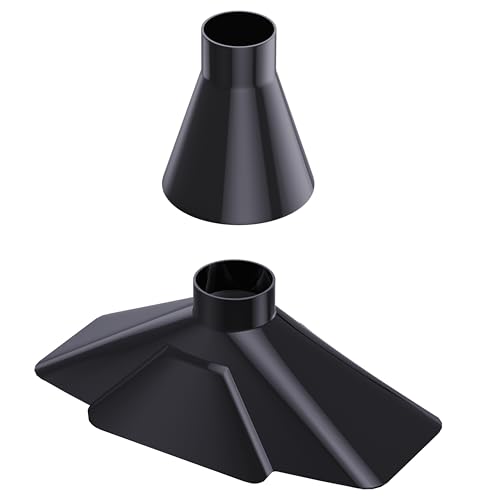
Best for precision work such as laser engraving and soldering that requires high heat resistance. The FC-2004 silicone hood offers robust performance with a 75mm diameter and resilient heat tolerance, making it suitable for applications where heat is a concern. Limitation: silicone capabilities depend on compatible ducting and source strength; verify compatibility with your system’s airflow.
VEVOR Ducted Fume Hood

Best for structured lab environments requiring steady airflow and visibility. It features a powerful centrifugal fan with vertical airflow and a stepless speed knob up to 3.9 m/s, plus a built-in G1 pre-filter to capture 3–10 μm particles. Durable construction uses powder-coated steel with a stainless steel base. Limitation: filter replacement is recommended every 2–3 months to maintain efficiency.
Buying Guide: Explosion-Proof Fume Hood Essentials
What is your primary use?
Choose an arm or hood based on the source type and scale of your operation. For fine, localized capture, a flexible arm (short to medium length) is ideal. For expansive workstations, a ducted hood with higher airflow control provides broader coverage and better containment.
How important is heat tolerance?
If you regularly work with high-temperature processes, select silicone or other heat-resistant hood materials. Ensure the hood diameter and mounting design accommodate your tools and heat output.
What about maintenance?
Look for smooth interior surfaces and easy-to-clean channels to minimize fume residue. Consider arms with simple joint mechanisms and robust supports to reduce drift and stabilize positioning after adjustment.
Airflow control and filtration
Hoods with adjustable speed and pre-filters help maintain consistent containment and reduce contamination. Verify compatibility with your facility’s ventilation system and the expected fume load.
Safety and installation considerations
Explosion-proof components should be evaluated for your specific chemical or particulate hazards. Ensure proper mounting, electrical grounding, and compliance with relevant safety standards for your workspace.
Cost versus benefit
Higher-cost options often deliver longer life, stronger containment, and lower maintenance, but balance against your budget and required performance. Consider total cost of ownership, including filters and parts replacement intervals.
FAQ
- What makes a hood explosion-proof? Design features and materials chosen to reduce ignition risk and handle flammable fumes in industrial settings.
- Are silicone hoods heat-resistant? Yes, silicone hoods are designed to withstand high heat from processes like laser engraving and soldering.
- How often should filters be replaced? Many systems benefit from 2–3 month intervals for pre-filters; follow manufacturer guidance for your model.
- Can I use these hoods in small spaces? Shorter arms or compact hood designs work best in tight areas, while longer arms require more clearance.
- Do these products require professional installation? Some setups, particularly ducted systems, may benefit from professional installation for optimal performance.
- Will these protect against all fumes? They provide containment for typical industrial fumes, but verify compatibility with the specific chemicals used in your operation.
Add a Comment