The top picks below cover a range of sheet metal rolling solutions, including 3-in-1 machines, dedicated slip rolls, and manual bead rollers. They’re chosen for versatility, durability, and practicality for hobbyists, small shops, HVAC installers, and DIY fabricators. Each product section explains who it’s best for and why it was selected, plus a quick caution when relevant. A compact buying guide and FAQ follow to help narrow choices.
| Product | Capacity | Best For | Notes |
|---|---|---|---|
| MechMaxx MMCB5220 | 52″ width; 20 GA | Versatile 3-in-1 workstation | Combines shear, brake, and slip roll |
| KAKA INDUSTRIAL 40″ 3-in-1 | 40″ width; 20 GA | Industrial-grade space saver | Back gauge and segment fingers |
| VEVOR Slip Roller 12.6″ | 12.6″ width; 1.0 mm | Compact bench roller | Detachable rollers for access |
| VEVOR 24-Inch Slip Roll | 24″ width; 16 GA | Higher capacity slip roll | Detachable rollers; smooth surface |
| KAKA INDUSTRIAL 36″ Slip Roll | 36″ width; 16 GA | High-capacity manual roll | Cast iron frame for stability |
Note: The table provides a quick snapshot of capacity and key strengths. For detailed specs, refer to each product section below.
MechMaxx 52-Inch 3-in-1 Pan, Box Brake, Slip Roll, Shear

The MechMaxx MMCB5220 combines three essential sheet metal operations in a single, wide-format machine. It integrates a shear, a brake, and a slip roll, enabling bending, cutting, and rolling of sheet metal in one compact footprint. This makes it best for a user who wants a versatile all-in-one unit for a small shop or home fabricator working with 20-gauge mild steel.
Best for: Hobbyists and small shops needing a compact 3-in-1 setup with a large 52″ work area and 20-gauge capability. The unit’s 1.96″ minimum rolling diameter supports forming small cylinders and arcs, while the reversible shear blade supports straight cuts across the 52″ length.
Caution: The integrated 3-in-1 design may require careful alignment when switching modes; plan setup time for each operation. Ensure adequate workspace for the back gauge and finger adjustments.
KAKA INDUSTRIAL 40-Inch 3-In-1 Metal Brake, Shear, Slip Roll
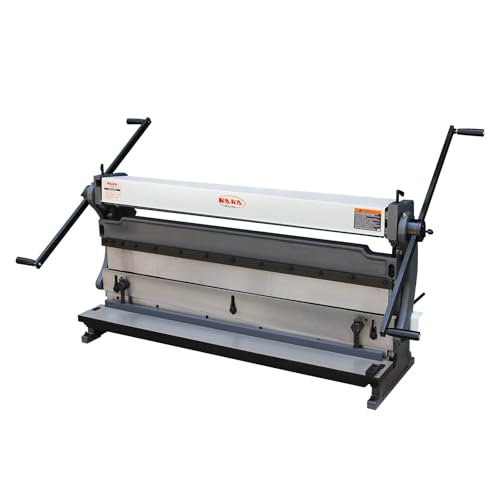
The KAKA INDUSTRIAL 40″ 3-in-1 machine combines heavy-duty 20-gauge shear, 90-degree brake dies, and a slip roll with back gauge and segment fingers. It’s designed to replace separate machines while saving workshop space. The frame is built for durability, making it a fitting choice for HVAC work, automotive fabrication, and general metal fabrication in semi-professional settings.
Best for: Shops needing a compact, space-saving all-in-one unit with reliable back gauge repeatability and detachable fingers for complex box/pan bends.
Limitation: As a larger 40″ unit with heavy components, installation and room for operation should be considered in advance to ensure proper clearance and safe handling during setup and use.
VEVOR Slip Roller, 12.6″ Width

The VEVOR Slip Roller 12.6″ focuses on compact, portable rolling for small sheets. It supports up to 1.0 mm steel and includes detachable rollers with three groove sizes for shaping rods and curves. Its small footprint makes it ideal for a benchtop setup in a home shop or a tutoring space where space is at a premium.
Best for: Beginners and hobbyists who want a straightforward, space-conscious slip roller with basic groove options for light metal forming.
Caution: The 12.6″ width limits larger projects; plan material sizes accordingly to avoid frequent repositioning.
VEVOR Slip Roll Machine, 24-Inch Forming Width
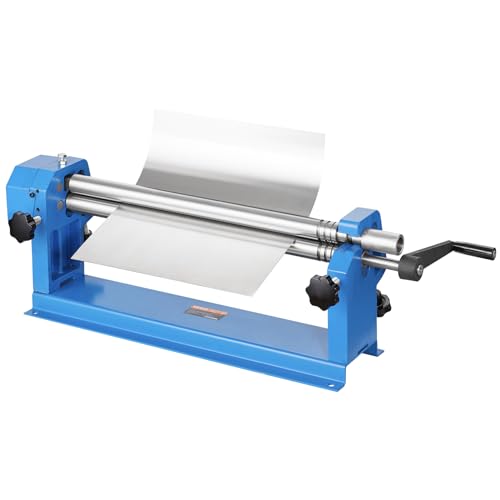
This 24-inch VEVOR model increases capacity to handle wider sheets with up to 16 gauge thickness. It features upgraded roller surface grinding for a smoother finish, detachable rollers for easy access, and improved gear gap precision for consistent operation. It suits semi-professional shops that require higher throughput on a bench or stand setup.
Best for: Experienced hobbyists or small shops needing a reliable medium-capacity slip roller with smoother finishes and easier access to finished pieces.
Limitation: Detachable roller design adds operational steps; ensure a stable work surface to maintain alignment during use.
KAKA INDUSTRIAL 36-Inch Slip Roll

The 36-inch KAKA INDUSTRIAL slip roll offers high-capacity manual operation with 16-gauge steel capability. Cast iron construction provides stability and minimizes deflection, which is critical for consistent curvature in larger projects. Three wire grooves support small stock forming, and the upper roll swings out for easy part removal.
Best for: Fabricators and HVAC installers needing a robust, high-capacity manual slip roll for larger panels and complex curves.
Limitation: Fully manual operation requires more physical effort; consider ergonomics for larger or longer working sessions.
Buying Guide
What to consider when choosing sheet metal rolling equipment:
- Project size and material: Match width and gauge capacity to your typical sheet sizes (12″–52″ widths, 16–20 gauge for most home shops).
- Machine type: If you need cutting, bending, and rolling in one workflow, a 3-in-1 unit saves space. For dedicated rolling, a standalone slip roll may be more affordable and easier to maintain.
- Rolled stock versatility: Look for multiple groove options and detachable rollers for handling rod, pipe, and curved profiles.
- Back gauge and alignment: A precise back gauge improves repeatability for batch work; this matters for production-style tasks.
- Build quality: Cast iron or heavy-duty steel frames reduce deflection and improve accuracy under load.
- Portability and space: Benchtop vs floor-standing models influence workshop layout and ease of use.
Practical buying tips
- Plan for safety: Ensure guards, clear clearance, and stable mounting to prevent accidents during operation.
- Future needs: Consider whether you might scale up to wider sheets or thicker gauges in the coming years.
- Maintenance: Check for easy blade and roller adjustments, and whether blades or rollers are user-serviceable.
FAQ
- What gauge can these machines typically handle? Most model lines target 16–20 gauge mild steel for rolling and bending, with variations by width and design.
- Do 3-in-1 machines really save space? Yes, they combine multiple operations in one unit, reducing the footprint compared to separate machines.
- Are detachable rollers important? Detachable rollers speed setup and allow easier removal of finished parts, especially with larger workpieces.
- Is a back gauge necessary? A back gauge improves repeatability and accuracy for batch work; consider models that include or allow a back gauge upgrade.
- Can I use these on aluminum or copper? Some models list compatibility with non-ferrous metals; verify the capacity and tool style for your material.
- What is the advantage of a cast-iron frame? Cast-iron frames reduce flex and improve long-term stability under load, enhancing precision.
Add a Comment