Find the right carbon steel ball valve manufacturer for high-pressure applications. This guide highlights five top products and explains who each valve is best for, plus practical buying considerations. Ideal buyers include industrial buyers prioritizing high-pressure tolerance, corrosion resistance, and secure operation. The table below compares key product details to help you decide quickly.
| Product | Port Size | Pressure Rating | Material | |
|---|---|---|---|---|
| MHA-Zentgraf 3/8” | 3/8” NPT | 7000 PSI (500 Bar) | High-pressure hydraulic lines | |
| MHA-Zentgraf 3/4” | 3/4” NPT | 6000 PSI (420 Bar) | Heavy-duty piping systems | |
| MHA-Zentgraf 1/2” | 1/2” NPT | 7000 PSI (500 Bar) | High-pressure distribution | |
| TAISHER 1/2” | 1/2” NPT | High-pressure rated | Industrial piping with varied fittings | |
| SKLSSVF 1/2” | 1/2” NPT | Standard heavy-duty | Corrosive environments with locking safety |
MHA-Zentgraf German Carbon Steel Ball Valve, 3/8” NPT

Product overview: German-made BKH heavy-duty valve with two female NPT ports. The steel construction offers enhanced corrosion and rust resistance. Suitable for temperatures from -20°C to +100°C and high-pressure piping up to 7000 PSI (500 Bar).
Best for: Heavy-duty hydraulic and high-pressure lines where reliability under extreme pressure is essential. This valve is ideal for engineers needing a robust, two-port shut-off in demanding environments.
Why selected: It combines German engineering with high-pressure capability and corrosion resistance, making it a strong match for critical hydraulic systems.
Limitations: Data emphasizes high pressure performance; ensure compatibility with your specific fluid and temperature range before installation.
MHA-Zentgraf German Carbon Steel Ball Valve, 3/4” NPT
Product overview: The 3/4” NPT version offers similar German craftsmanship with two female threads and high-pressure tolerance. Designed for demanding piping systems with strong corrosion resistance.
Best for: Projects needing a larger port size while maintaining high pressure tolerance in hydraulic networks.
Why selected: It offers a balance of size, strength, and reliability for mid- to high-capacity installations.
Limitation: Slightly larger footprint than the 3/8” model; check space and compatibility with existing fittings.
MHA-Zentgraf German Carbon Steel Ball Valve, 1/2” NPT
Product overview: This 1/2” NPT valve provides two female ports, built for high-pressure service with corrosion-resistant steel construction suitable for extreme conditions.
Best for: Systems requiring a compact yet high-strength valve within hydraulic or high-pressure loops.
Why selected: Combines compact size with high-pressure capability for tight installations.
Limitation: Data focuses on high-pressure capability; verify seal compatibility with your fluid.
TAISHER 1/2″ NPT High Pressure Hydraulic Ball Valve

Product overview: KBH 1/2″ NPT valve designed for industry connections with varied end types. Carbon steel with galvanized surface and high-quality NBR sealing for high-pressure environments.
Best for: Industrial setups requiring robust sealing and a galvanized finish for added corrosion resistance.
Why selected: Provides practical sealing and compatibility for high-pressure piping with diverse end types.
Limitation: Sealing material is NBR; consider fluid compatibility with NBR seals for temperatures and chemicals beyond standard ranges.
SKLSSVF 2 Pack 1/2″ Ball Valves with Locking
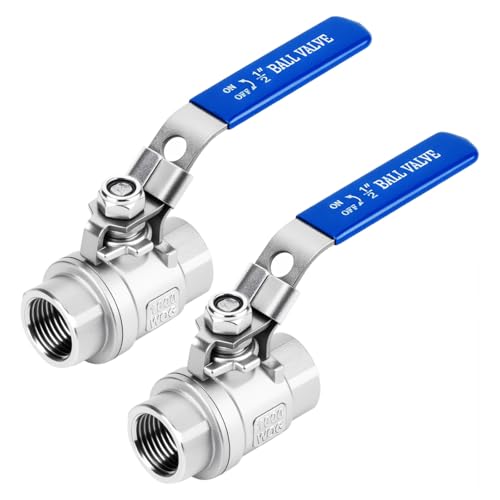
Product overview: Stainless steel 304 full-port ball valves with locking handle for safety. Suitable for home and industrial use, offering corrosion resistance and secure operation.
Best for: Environments requiring long-term corrosion resistance and secure lever retention, such as chemical plants or outdoor installations.
Why selected: Stainless body and locking feature provide both durability and operational safety in high-risk settings.
Limitation: Stainless steel variants may not match all carbon steel systems; verify material compatibility with fluids and temperatures.
Apollo 83A-240 Carbon Steel Ball Valve Set

Product overview: Three-piece valve with carbon steel body, stainless steel 316 ball and stem for corrosion resistance. Inline, lever operation with a two-position locking vinyl sleeve, designed for robust service.
Best for: Applications needing a combination of carbon steel strength and stainless components for corrosion-prone environments.
Why selected: The dual material approach offers enhanced durability under demanding service conditions.
Limitation: Three-piece design can be more complex to service; ensure proper maintenance procedures.
Buying Guide
What to consider when choosing a carbon steel ball valve
- Pressure rating and port size: Match valve size and PSI/Bar rating to your system’s requirements. Higher pressure valves are essential for hydraulic and high-flow services.
- Material and corrosion resistance: Carbon steel provides strength, but consider additional coatings or stainless components for corrosive fluids or outdoor use.
- End connections and installation space: Verify NPT threads and available space, especially for 3/8” and 1/2” valves in tight layouts.
- Sealing and seals longevity: Evaluate seal materials (NBR, FKM) for chemical compatibility and temperature range.
- Operability and safety: Locking handles reduce accidental actuation; consider two-position locking or locking variants for safety-critical environments.
- Maintenance and serviceability: Three-piece valves offer easier repair in some installations, but require more maintenance planning.
What configuration fits your system?
- Two-port shut-off vs. flow-control: For simple isolation, choose two-port shut-off valves. For hydraulic control, consider valves designed for flow regulation with robust seating.
- Temperature range: Ensure the valve operates within your system’s temperatures to avoid seal degradation or material fatigue.
- Combination with stainless components: If corrosion risk is high, consider valves with stainless balls or stems to extend service life.
Quick comparison by scenario
- Best for high-pressure hydraulic lines: MHA-Zentgraf 3/8” and 1/2” models.
- Better for larger piping and mid-range pressure: MHA-Zentgraf 3/4” model.
- Choose this if you need locking safety in industrial settings: SKLSSVF 1/2” with locking handle.
- Avoid this if your fluid is strongly aggressive to NBR seals: review seal material suitability.
FAQ
- What is a carbon steel ball valve used for in high-pressure systems?
It provides reliable shut-off and flow control in hydraulic and industrial piping with high pressure ratings.
- Are carbon steel valves suitable for corrosive fluids?
They can be, especially with protective coatings or stainless components; verify corrosion resistance for the specific fluid.
- What should I consider when selecting port size?
Choose a size that matches existing piping and required flow, keeping in mind space constraints.
- Do locking handles improve safety?
Yes, locking handles prevent accidental valve operation in hazardous environments.
- Which material combination offers the best durability?
Valves with stainless steel balls or stems and corrosion-resistant bodies tend to last longer in challenging conditions.
- Is maintenance easier for two-port or three-piece valves?
Two-port valves are simpler; three-piece designs allow easier in-field maintenance but require more upkeep planning.
Add a Comment