Find the right industrial chain drive sprockets for reliable power transmission. This guide highlights five solid options suited for heavy-duty conveyors, farming equipment, and manufacturing lines. Each choice balances durability, compatibility with ANSI #40 or similar chains, and secure mounting features. Best for maintenance planners, machine builders, and shop technicians seeking trustworthy, steel sprockets with hardened teeth and compatible hubs.
| Product | Bore | Teeth | Brand |
|---|---|---|---|
| Jeremywell #40 Roller Chain Sprocket | 5/8″ | 48 | Jeremywell |
| RHKING #40 Roller Chain Sprocket | 1″ | 24 | RHKING |
| CHR #40 Roller Chain Sprocket | 1″ | 21 | CHR PRECISION IN DETAIL |
| Saelno #40 Roller Chain Sprocket | 1″ | 24 | Saelno |
| #50 Roller Chain Sprocket – 25 Teeth | 3/4″ | 25 | HJGuamou |
Jeremywell #40 Roller Chain Sprocket, 48 Teeth

Best for high-torque conveyors and machinery that require a 5/8″ bore. Features indicate a 48-tooth configuration, suitable for ANSI #40 chains with robust engagement. The bore size matches common shaft standards, aiding alignment. Suitable for maintenance teams needing a ready-to-install, mid-range sprocket with dependable tooth form.
Who this is for: shops upgrading a rolling chain drive that uses 5/8″ bore and 48 teeth. Why chosen: reliable mid-to-high tooth count provides longer life under pulsed loads. Caution: ensure shaft bore and keyway align with your shaft to avoid misalignment during installation.
RHKING #40 Sprocket, 24 Teeth, 1″ Bore

Best for medium-duty drives that require a 1″ finished bore with a 24-tooth configuration. The data emphasizes AISI 1045 carbon steel and heat-treated teeth for wear resistance. The rust- and corrosion-resistant finish supports outdoor or dusty environments.
Who this is for: agricultural and light industrial lines needing durable steel sprockets with straightforward mounting. Why chosen: good balance of hardness (HRC38-42) and bevel-teeth performance. Caution: ensure 1″ bore fits your shaft without excessive clearance or play.
CHR #40 Sprocket, 21 Teeth, 1″ Bore

Best for ANSI #40 chains in compact drive setups where space is limited. The 21-tooth design provides a compact gear ratio suitable for slower speeds or higher torque per tooth. Carbon steel construction with B-hub mounting ensures reliable shaft engagement.
Who this is for: projects needing a compact, yet strong sprocket. Why chosen: solid performance for conveyors or mixer augers with limited clearance. Caution: check chain compatibility; 21 teeth may alter chain tension on existing runs.
Saelno #40 Sprocket, 24 Teeth, 1″ Bore

Best for ANSI #40 chains in corrosive or outdoor settings due to the corrosion-resistant finish. The hardened teeth (HRC38-42) and blackened surface extend wear life under continuous operation. 1″ bore supports common shaft sizes in industrial lines.
Who this is for: maintenance crews in outdoor or damp environments needing rust resistance. Why chosen: hardened tooth surface reduces wear and prolongs chain life. Caution: verify keyway size and set-screw compatibility for secure mounting.
HJGuamou #50 Sprocket, 25 Teeth, 3/4″ Bore
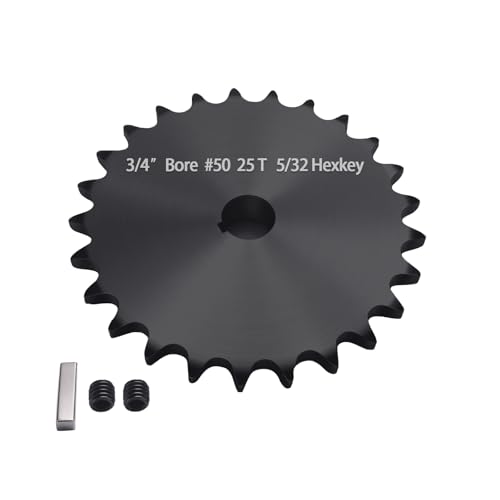
Best for heavier-duty drives in conveyors, farm equipment, and industrial drives requiring a 3/4″ bore and 25 teeth. The black oxide finish provides rust resistance, while the included set screws and key simplify secure shaft mounting. Designed for high-torque sections of a line.
Who this is for: heavy-duty systems where resilient mounting matters and space allows a 3/4″ bore. Why chosen: combination of extra tooth and robust mounting hardware makes it a strong option for demanding drives. Caution: verify shaft and bore tolerances to avoid wobble under high torque.
Buying Guide
Key considerations when selecting an industrial chain drive sprocket:
- Chain compatibility: Ensure the sprocket matches ANSI #40 or the exact chain pitch used in your system.
- Bore and mounting: Confirm bore diameter, keyway size, and hub type (B-type) to match your shaft and mounting hardware.
- Tooth count and diameter: Higher tooth counts distribute load better and extend life; choose teeth to balance torque, speed, and space constraints.
- Material and treatment: Hardened teeth and corrosion resistance extend life in dusty, humid, or outdoor environments.
- Environmental conditions: Outdoor use or exposure to chemicals may require rust-resistant finishes or coated steel.
- Maintenance access: Consider whether you need ready access for inspection and replacement during routine maintenance.
Practical buying tips
- When replacing a sprocket, match the existing chain pitch, bore size, and mounting type to avoid misalignment.
- For wet or outdoor environments, prioritize corrosion-resistant finishes and hardened teeth.
- If space is tight, a smaller bore with more compact teeth can fit where a larger hub would not.
FAQ
- What is the difference between a B-type and a C-type hub? Answer: B-type hubs provide a standard set-screw mounting; other hub types can vary by pattern and mounting method.
- Why choose a hardened tooth sprocket? Answer: Hardened teeth resist wear and extend service life under high torque and continuous operation.
- Can I use an ANSI #40 sprocket with any #40 chain? Answer: Yes, provided the bore and hub match your shaft and mounting hardware.
- How do I determine the correct bore size? Answer: Measure your shaft diameter and match to the closest standard bore size listed by the sprocket.
- Are rust-proof finishes necessary in indoor controls? Answer: They are beneficial in humid or dusty environments, even indoors, to reduce corrosion over time.
- What about installation torque for set screws? Answer: Follow manufacturer guidelines; overtightening can damage the shaft, while under-tightening can cause slipping.
Add a Comment