When choosing a 4-gas detector for confined spaces, accuracy, reliability, and ease of use are essential. This guide highlights five top options that balance performance with practical features for workers and safety teams. Each product is suited for different environments, from industrial sites to home safety checks. The selections emphasize fast response, durable construction, and clear alarms to help you decide which model is best for your needs.
| Product | Best For | Key Benefit |
|---|---|---|
| TopTes Guard-101 | General work sites | Fast 0.5s response; USB alarm storage |
| FORENSICS DETECTORS FD 4 Gas Monitor + Pump | Confined spaces with pumping needs | Built-in pump and calibration certificate |
| Forensics FD 4 Gas Monitor (No Pump) | Micro environments and data logging | Color display and NIST calibration |
| TopTes Guard-863Pro | High-usage work sites | 5-year O2 sensor; TFT display |
| Forsensal Gas Detector with Pump | Hard-to-reach areas | Rechargeable battery; pump option |
TopTes Guard-101 Gas Detector
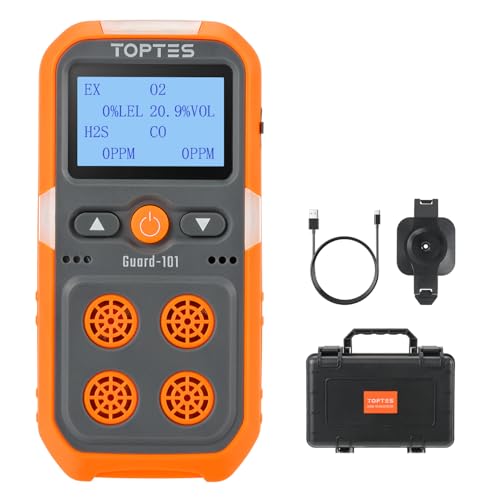
The Guard-101 detects four gases—H2S, CO, LEL, and O2—with a fast 0.5-second response and triple alarm modes (LED, vibration, and audible). Its 14-hour battery life supports longer shifts, and its rugged ABS housing is waterproof, dustproof, and explosion-proof. This model includes a back clip for easy carrying and a password lock to prevent accidental operation, making it suitable for general contractors and industrial technicians. A potential limitation is the battery life in very cold conditions, which can slightly reduce runtime.
USA NIST Calibrated 4 Gas Monitor (Forensics)

This detector includes USA NIST traceable calibration for O2, CO, H2S, and LEL sensors, offering tighter calibration accuracy and precise detection. It features adjustable alarms with audio, visual, and vibration alerts and provides an alarm timestamp for records. Best for environments where standardized calibration is essential and data tracking is needed. A limitation is that calibration specifics and maintenance intervals should be followed to maintain NIST-traceable accuracy.
4 Gas Meter for Confined Space (Forensics)

This model uses high-quality nano sensors for O2, CO, H2S, and LEL with factory calibration and a user-friendly adjustable alarm system. It supports zero and span calibration, helping maintain accuracy over time. It is best for workers needing compact meters with straightforward calibration options. A caveat is that some users may require regular calibration to sustain sensor accuracy in harsh environments.
TopTes Guard-863Pro 4 Gas Monitor

The Guard-863Pro offers a TFT color display and an upgraded O2 sensor with a 5-year lifespan. It provides fast 0.5-second detection and a continuous triple alarm system, with USB data export for alarm and fault logs. This model is well-suited for workplaces requiring clear data views and long-component life. A potential limitation is higher complexity due to the richer data features, which may require more training for new users.
4 Gas Monitor With Pump (Forensics FD)

This detector combines a built-in pump with four gases and a calibration certificate, making it ideal for confined spaces where active sampling is beneficial. It includes a calibration certificate and a 1-year warranty-like assurance in documentation. Best for professionals who need a pumping option for gas sampling at height or behind barriers. A limitation is that pump-based devices can be bulkier and require more maintenance than diffusion-only models.
Buying Guide
What should you consider when selecting a 4-gas detector for confined spaces?
- Gas coverage: Ensure the device monitors O2, CO, H2S, and LEL with reliable sensor technology appropriate for your environment.
- Alarm systems: Look for multi-sensor alerts (audible, visual, and vibration) and data logging for compliance and post-incident analysis.
- Calibration and data: Prefer models with NIST calibration options or easy calibration procedures and exportable data for records.
- Power and durability: Consider battery life, recharge options, and rugged housing suitable for wet or dusty workplaces.
- Pump vs. diffusion: Pumps suit hard-to-reach areas; diffusion meters are compact but may be less effective in certain confined spaces.
- Display and usability: A color TFT display or straightforward interfaces improve readability in low-light settings.
How to choose between models with and without a pump
Choose a pump-equipped model if you need active sampling in tight, obstructed, or vertical spaces. For open or standard confined spaces, a diffusion-style meter can be lighter and easier to carry. Consider battery life and maintenance when deciding.
Data handling and compliance considerations
For worksite compliance, prioritize devices with NIST calibration options and clear data logging. Export capabilities help with audits, incident investigations, and trend analysis.
Frequently Asked Questions
- What is a 4-gas detector used for in confined spaces?
It detects oxygen, carbon monoxide, hydrogen sulfide, and combustibles to maintain safe entry conditions.
- Do all 4-gas meters have pumps?
No. Some use diffusion sampling, while others include a built-in pump for faster air sampling in blocked or distant areas.
- What does NIST calibration provide?
NIST calibration offers traceable, standardized accuracy for gas readings, useful for compliance and reporting.
- How long do these detectors typically last on a charge?
Battery life varies by model; many provide 8–14 hours, with some premium units offering longer runtimes.
- Is a color display beneficial on a gas detector?
Yes. Color displays improve quick interpretation of gas levels, especially in low-light environments.
- What should be checked before using a gas detector daily?
Check sensors, battery charge, alarms, date of last calibration, and data logging readiness.
Add a Comment